
Sales qualification shapes every successful real estate deal. Agents who ask the right questions can save hours chasing unqualified leads and focus on clients who are ready to take action. But what if filtering out the wrong prospects actually does more than just free up your schedule? The real surprise is that top-performing agents can increase their conversion rates by over 50 percent simply by using smarter qualification conversations. That unexpected jump is proof it isn’t just about asking questions. It’s about asking the right ones at the right time.
Table of Contents
- Why Sales Qualification Matters In Real Estate
- Top Sales Qualification Questions To Ask Leads
- Customizing Qualification Questions For Your Market
- Tips For Effective Lead Qualification Conversations
Quick Summary
| Takeaway | Explanation |
|---|---|
| Effective qualification saves time and increases revenue. | Focus on leads most likely to convert to streamline your efforts and maximize financial potential. |
| Ask strategic questions to uncover motivations. | Delve deeper with questions about clients’ reasons and timelines to prioritize engagement effectively. |
| Customize questions to your local market. | Tailor your qualification approach by considering local demographics and market conditions for relevance. |
| Master active listening to build trust. | Engage in conversations attentively, using techniques that confirm understanding and demonstrate genuine interest. |
| Adapt qualification techniques to market changes. | Flexibility in questioning strategies is essential to remain aligned with evolving customer needs and market dynamics. |
Why Sales Qualification Matters in Real Estate
Real estate professionals understand that not every lead transforms into a successful transaction. Sales qualification emerges as a critical strategy to filter and focus on prospects most likely to convert, ultimately saving time and maximizing revenue potential.
The Economics of Targeted Lead Engagement
Effective sales qualification goes beyond simple screening. According to Baylor University’s Keller Center for Research, high-performing sales agents demonstrate sophisticated procedural knowledge that allows them to recognize and adapt to specific client needs with remarkable precision.
The real estate market demands strategic approach. Agents who implement robust qualification processes can dramatically reduce wasted effort and increase conversion rates. By systematically evaluating potential clients’ motivations, financial capabilities, and genuine interest, professionals create a more streamlined pathway to successful transactions.
Skill Sets That Drive Qualification Success
Interestingly, research from the U.S. Bureau of Labor Statistics emphasizes that real estate professionals must possess strong interpersonal skills to effectively interact with clients. These skills are fundamental in identifying genuine prospects and distinguishing between casual inquiries and serious buyers.
Emotional intelligence plays a pivotal role in this process. Agents who can read between the lines, understand underlying client motivations, and ask penetrating qualification questions can significantly improve their success rates. The ability to quickly assess a lead’s potential becomes a competitive advantage in a dynamic real estate market.
Building Long-Term Client Relationships
Qualification is not just about immediate sales but about cultivating lasting relationships. By investing time in understanding client needs upfront, agents create trust and increase the likelihood of future referrals and repeat business. Check out our comprehensive guide on qualifying real estate leads for advanced strategies that transform initial interactions into meaningful connections.
Baylor University’s research further reinforces that relationship management skills are critical. Agents who master the art of qualification demonstrate a commitment to their clients’ unique journeys, setting themselves apart in a competitive marketplace. This approach transforms sales qualification from a mere filtering mechanism into a strategic tool for sustainable business growth.
Ultimately, sales qualification in real estate is about precision, empathy, and strategic engagement. It represents a sophisticated approach to lead management that respects both the agent’s time and the potential client’s needs.
Top Sales Qualification Questions to Ask Leads
Successful real estate professionals understand that strategic questioning is the cornerstone of effective lead qualification. The right questions can transform casual inquiries into potential transactions, enabling agents to focus their energy on high-potential clients.
Understanding Client Motivation and Urgency
The first step in qualification involves uncovering the client’s underlying motivations. According to research from GSIX, critical initial questions should probe deeper than surface-level interests. Key questions include:
- What’s driving your decision to buy/sell? This reveals personal circumstances and emotional triggers.
- When are you looking to take action? Understanding timeline helps prioritize leads.
- What challenges have you encountered in your property search/sale? This provides insight into potential barriers.
Financial Readiness and Budget Assessment
Coursera’s sales research highlights the importance of understanding a client’s financial landscape. Effective qualification requires nuanced financial questions:
- Have you been pre-approved for a mortgage?
- What’s your budget range for this property?
- Are you prepared for additional costs like closing fees and potential renovations?
These questions help agents quickly determine whether a lead has the financial capacity to complete a transaction. Learn more about advanced lead qualification strategies to refine your approach.
Comprehensive Client Profile Development
Beyond financial and motivational questions, top real estate professionals build comprehensive client profiles. This involves understanding lifestyle preferences, long-term goals, and specific property requirements.
Additional critical questions include:
- What specific features are non-negotiable in your ideal property?
- Are you working with other real estate agents?
- What’s your preferred communication method and frequency?
By systematically gathering this information, agents can personalize their approach, demonstrating value and increasing the likelihood of successful conversion. The goal isn’t just to ask questions but to listen actively, building trust and understanding that transforms leads into loyal clients.
To help real estate professionals quickly assess and remember which qualification questions to ask depending on the lead type, here’s a summary table outlining key question categories and sample questions for each qualification area:
| Qualification Area | Sample Qualification Questions |
|---|---|
| Client Motivation & Urgency | What’s driving your decision to buy/sell? When are you looking to take action? |
| Financial Readiness & Budget Assessment | Have you been pre-approved for a mortgage? What’s your budget range for this property? |
| Comprehensive Client Profile Development | What features are non-negotiable in your ideal property? Are you working with other agents? |
| Market-Specific Contextual Questioning | What neighbourhood amenities are important to you? How does the commute influence your decision? |
| Demographic-Driven Qualification | Are you a first-time homebuyer? Are sustainable living features important to you? |
| Adapting to Market Volatility | Are you flexible with closing dates? How quickly do you need to make a decision if you find the right home? |
This table organizes the main qualification themes and example questions discussed, making it easy to reference during conversations.

Remember, effective sales qualification is an art of strategic conversation. Each question should be asked with genuine interest, creating a consultative experience that sets you apart in a competitive real estate market.
Customizing Qualification Questions for Your Market
Real estate markets are not monolithic. Each geographic region, demographic segment, and property type demands a nuanced approach to lead qualification. Successful agents recognize that a one-size-fits-all strategy fails to capture the unique dynamics of their specific market.
Market-Specific Contextual Questioning
According to Baylor University’s Keller Center Research, identifying unconsidered needs of potential buyers is crucial. This means developing qualification questions that go beyond standard inquiries and dive deep into the specific context of your local market.
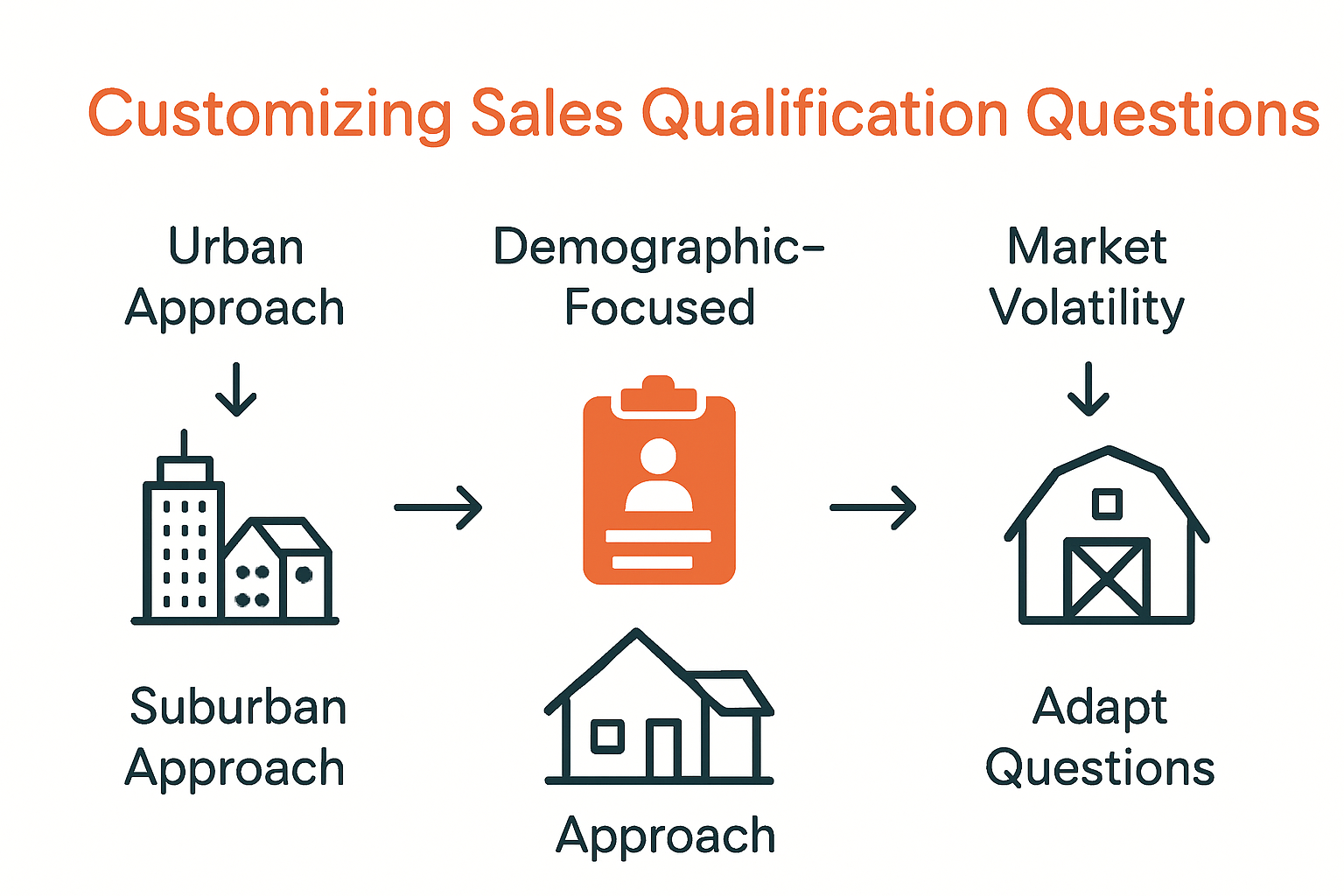
For urban markets, questions might focus on proximity to public transportation, workplace commute times, and neighborhood amenities. Suburban markets may prioritize school district quality, property lot sizes, and community infrastructure. Rural markets could emphasize land usage, agricultural potential, and distance from essential services.
To clarify the differences in qualification approaches for various real estate markets, here is a comparison table summarizing the market-specific contexts and their relevant qualification priorities:
| Market Type | Focus of Qualification Questions | Typical Priorities |
|---|---|---|
| Urban | Proximity to transportation, amenities, commute times | Convenience, accessibility, neighbourhood facilities |
| Suburban | School district quality, lot size, community infrastructure | Family needs, schools, outdoor space |
| Rural | Land usage, distance to services, agricultural potential | Land potential, privacy, essential services |
| Investor-Focused | Rental yields, appreciation rates, local market trends | ROI, cash flow, property value growth |
| Millennial | Smart home features, sustainability, tech adoption | Eco-friendliness, connectivity, modern amenities |
| Retirement/Elder | Accessibility, maintenance, downsizing options | Ease of living, low maintenance, adaptability |
This table enables agents to tailor their qualification questions based on the unique characteristics of each market or demographic segment.
Demographic-Driven Qualification Approach
Different demographic groups require tailored questioning strategies. First-time homebuyers need questions that explore their financial readiness and long-term housing aspirations. Investors require questions about potential rental yields, property appreciation rates, and market trends.
Millennial buyers might be interested in smart home features and sustainable living options. Retirement-age clients could prioritize accessibility, maintenance requirements, and potential downsizing opportunities. Learn more about advanced lead targeting techniques to refine your approach.
Adapting to Market Volatility
Market conditions continuously evolve, demanding flexible qualification strategies. Research from North Central Missouri College emphasizes the importance of a seven-step selling process that adapts to changing customer needs and market situations.
In a competitive seller’s market, qualification questions might focus on buyers’ flexibility and financial strength. During buyer’s markets, questions could explore more detailed preferences and willingness to negotiate. Economic shifts require agents to modify their qualification approach, ensuring they remain responsive to current market dynamics.
Key considerations for market-specific customization include:
- Local economic indicators
- Demographic shifts
- Emerging neighborhood trends
- Technology adoption rates
- Generational housing preferences
Effective qualification is not about interrogation but creating a consultative dialogue that demonstrates your deep understanding of the client’s unique context. By crafting questions that reflect local market nuances, real estate professionals can distinguish themselves as true market experts who provide genuine value beyond transactional interactions.
Tips for Effective Lead Qualification Conversations
Lead qualification conversations are the critical bridge between initial contact and potential transaction. Real estate professionals must master the art of communication to transform casual inquiries into meaningful client relationships.
The Art of Active Listening
According to Louisiana REALTORS, effective communication begins with active listening. This means fully concentrating on what the client is saying, rather than simply waiting to respond. Key techniques include:
- Maintaining consistent eye contact
- Avoiding interruptions
- Reflecting back what you’ve heard to confirm understanding
- Paying attention to non-verbal cues
Active listening demonstrates genuine interest and helps build trust. Clients want to feel heard and understood, not just processed through a sales funnel.
Communication Strategies and Conversation Flow
Baylor University’s Keller Center Research provides a strategic framework called WIIFT (Wait, Initiate, Investigate, Facilitate, Then Consolidate) for effective sales conversations. This approach emphasizes:
- Waiting and observing before jumping into questions
- Initiating conversation with genuine interest
- Investigating client needs thoroughly
- Facilitating solutions tailored to their specific requirements
- Consolidating understanding before moving forward
Explore our comprehensive guide to lead qualification techniques to refine your approach and maximize conversion potential.
Navigating Non-Verbal Communication
Workforce LibreTexts highlights the critical importance of face-to-face communication in real estate. Non-verbal cues often reveal more than spoken words:
- Body language can indicate genuine interest or hesitation
- Tone of voice provides emotional context
- Physical proximity and posture communicate comfort levels
- Facial expressions offer insights into client’s true feelings
Professional real estate agents learn to read these subtle signals, adjusting their approach in real-time to create more authentic and productive conversations.
Remember, effective lead qualification is not about aggressive selling but about creating a consultative experience. Your goal is to understand the client’s needs, provide value, and build a foundation of trust that extends beyond a single transaction.
Frequently Asked Questions
What are some effective sales qualification questions for real estate leads?
Asking about a client’s motivations for buying or selling, their timeline for action, and their financial readiness are essential qualification questions. Additionally, inquiring about specific property features they desire can help tailor your approach.
Why is sales qualification important in real estate?
Sales qualification helps agents focus their efforts on prospects most likely to convert into transactions. By filtering out unqualified leads, agents save time and resources while significantly increasing their conversion rates.
How can I adapt my sales qualification questions to different markets?
Customize your qualification questions based on local market trends, demographic needs, and specific client situations. Urban areas may prioritize amenities and public transport, while rural settings might focus on land use and accessibility to services.
What role does active listening play in lead qualification?
Active listening is crucial in lead qualification as it helps build trust and shows clients that their needs are genuinely valued. Engaging with clients attentively, reflecting what they express, and noting non-verbal cues can significantly enhance the quality of the conversation.
Ready to Qualify Real Estate Leads While You Sleep?
You have just learned how the right sales qualification questions can transform your business, save valuable time, and boost your conversion rates. But many real estate pros struggle to keep up with fast-moving leads, follow up consistently, and ask the right questions for every situation. Every hour a lead goes unanswered means missed opportunities and lost revenue. Imagine being able to automate strategic qualification questions, respond instantly to every inquiry, and never miss booking an appointment again.

Take control of your lead qualification and turn more prospects into clients with the power of AI. With LeadLinker.co you can automate conversations on every platform and always reach out at the perfect moment. Discover how top agents are achieving higher response rates and seeing more appointments by using our AI-driven lead qualification tools. Do not let another qualified lead slip through the cracks. Start your transformation now and see results for yourself.