
Real estate pros talk a lot about the power of data. Tracking performance goes way past counting sold homes or showing off big commissions. Surprise, most agents do not realize that metrics like lead conversion rates and client satisfaction scores are just as important as final sales volume. The real advantage comes when agents dig into these numbers to spot hidden strengths and gaps they never saw coming.
Table of Contents
- Defining Agent Performance Metrics: What They Are And Their Purpose
- The Importance Of Measuring Agent Performance In Real Estate
- Key Metrics Used To Evaluate Real Estate Agents’ Success
- Interpreting Agent Performance Data: Making Sense Of The Numbers
- Using Agent Performance Metrics For Strategic Decision Making
Quick Summary
| Takeaway | Explanation |
|---|---|
| Track key performance metrics | Monitor total sales volume, closed transactions, and client satisfaction to gauge effectiveness. |
| Identify strengths and weaknesses | Utilize metrics to pinpoint areas for personal development and business improvement. |
| Leverage data for strategic decisions | Use performance insights to craft marketing strategies and enhance client engagement. |
| Benchmark against peers | Assess your metrics relative to industry benchmarks for better market positioning. |
| Transform data into actionable insights | Analyze metrics to recognize trends, forecast performance, and adapt strategies accordingly. |
Defining Agent Performance Metrics: What They Are and Their Purpose
Agent performance metrics represent a comprehensive system of quantitative measurements used to evaluate and track the effectiveness, productivity, and success of real estate professionals. These metrics go beyond simple sales numbers, providing a nuanced view of an agent’s capabilities, client interactions, and overall business performance.
Understanding the Core Components
At their fundamental level, agent performance metrics encompass multiple dimensions of professional achievement. According to a study by University of Florida’s Warrington College of Business, these metrics can include:
- Total sales volume
- Number of closed transactions
- Average time properties spend on the market
- Listing price accuracy
- Client satisfaction ratings
- Lead conversion rates
Strategic Importance of Performance Tracking
Tracking these metrics serves multiple strategic purposes for real estate professionals. Performance metrics enable agents to:
- Identify personal strengths and improvement areas
- Set realistic and data-driven business goals
- Understand market positioning compared to peers
- Make informed decisions about marketing and client engagement strategies
Real estate is a competitive field where data-driven insights can significantly differentiate top performers. By understanding and leveraging agent performance metrics, professionals can develop targeted strategies to enhance their business effectiveness.
The table below compares the main types of real estate agent performance metrics, summarizing each type and outlining the purpose they serve in professional development and business strategy.
| Metric Type | Examples | Purpose/Benefit |
|---|---|---|
| Quantitative | Total sales volume, closed transactions, | Measures productivity, revenue generation, and market |
| commissions, days on market | performance with concrete data | |
| Qualitative | Client satisfaction, testimonials, | Evaluates client experience, professionalism, and soft |
| marketing effectiveness, communication | skills influencing business growth | |
| Comparative/Benchmarking | Relative performance vs. peers, industry | Assesses market position and competitiveness |
| benchmarks | ||
| Development/Improvement | Strengths and gaps analysis, skill | Identifies growth areas and supports targeted |
| development trends | professional development |
The Importance of Measuring Agent Performance in Real Estate
Measuring agent performance is a critical strategy that transforms raw data into strategic insights, enabling real estate professionals to understand their market position, refine their approach, and drive sustainable business growth. By systematically tracking and analyzing performance metrics, agents can make informed decisions that directly impact their professional success.
Performance Metrics as a Business Intelligence Tool
Performance metrics serve as a sophisticated business intelligence mechanism that goes beyond simple numerical evaluations. According to the National Association of Realtors, these metrics provide a multidimensional view of an agent’s professional capabilities, revealing:
- Areas of exceptional performance
- Potential skill development opportunities
- Comparative market positioning
- Individual and team productivity trends
Strategic Benefits of Comprehensive Performance Tracking
Performance measurement offers agents significant strategic advantages. By implementing robust tracking systems, real estate professionals can:
- Develop targeted professional development strategies
- Create data-driven business improvement plans
- Identify and replicate successful sales approaches
- Optimize client engagement and communication methods
The real estate landscape is increasingly competitive, making performance metrics an essential tool for professionals seeking to differentiate themselves. Explore advanced performance tracking techniques to transform your business strategy and achieve measurable growth.
Key Metrics Used to Evaluate Real Estate Agents’ Success
Successful real estate professionals understand that comprehensive performance evaluation extends far beyond traditional sales numbers. Modern agent performance assessment involves a sophisticated approach that captures multiple dimensions of professional effectiveness and business impact.
This table summarizes key quantitative and qualitative metrics used to evaluate real estate agents, along with a brief description for each to clarify their significance.
| Metric | Type | Description |
|---|---|---|
| Total sales volume | Quantitative | Gross dollar value of all transactions closed |
| Number of closed transactions | Quantitative | Total completed property sales in a given period |
| Average commission earned | Quantitative | Mean earnings per closed deal |
| Time properties spend on market | Quantitative | Average days a property is listed before it sells |
| Client satisfaction/testimonials | Qualitative | Ratings and feedback from past clients |
| Communication responsiveness | Qualitative | Speed and quality of replies to client inquiries |
| Marketing strategy effectiveness | Qualitative | Success of campaigns in attracting and converting leads |
| Negotiation and deal completion | Qualitative | Ability to secure favourable terms and close deals |
Quantitative Performance Indicators
According to the U.S. Bureau of Labor Statistics, real estate performance metrics can be categorized into several key quantitative measurements:
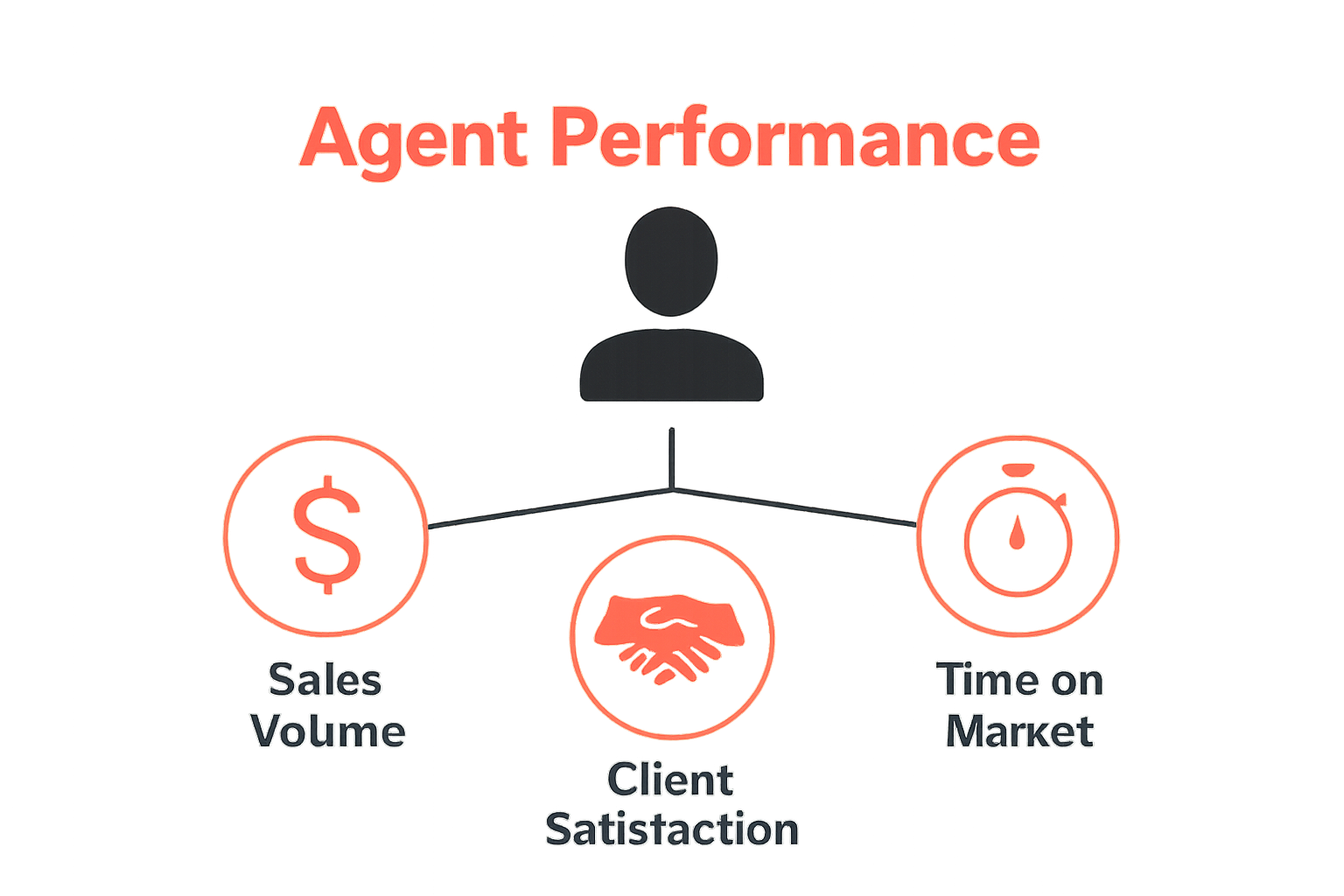
- Total sales volume
- Number of closed transactions
- Average commission earned
- Time properties spend on market
- Ratio of listing price to final sale price
- Geographic market penetration
Qualitative Performance Assessment
Beyond numerical metrics, successful agents are evaluated on qualitative factors that demonstrate professional excellence. These nuanced indicators include:
- Client satisfaction and testimonial quality
- Professional network and referral generation
- Communication responsiveness
- Marketing strategy effectiveness
- Negotiation skills and deal completion rates
The complexity of these metrics underscores the multifaceted nature of real estate professional success. Discover advanced strategies for tracking agent performance to transform raw data into actionable business intelligence and competitive advantage.
Interpreting Agent Performance Data: Making Sense of the Numbers
Interpreting agent performance data requires a nuanced approach that goes beyond surface-level number crunching. Successful real estate professionals understand that performance metrics are not just isolated statistics, but interconnected insights that reveal deeper patterns of professional effectiveness and market dynamics.
Contextualizing Numerical Performance
According to the Texas Real Estate Commission, effective data interpretation involves understanding the broader context of each metric. Key considerations for meaningful analysis include:
- Comparing metrics against industry benchmarks
- Recognizing seasonal market variations
- Understanding local economic influences
- Identifying consistent performance trends
- Evaluating metrics relative to specific market segments
Translating Data into Actionable Insights
Raw performance data becomes valuable only when transformed into strategic intelligence. Real estate professionals should focus on:
- Identifying consistent strengths and improvement areas
- Developing targeted professional development strategies
- Recognizing patterns that indicate market opportunities
- Adjusting business approaches based on data trends
- Predicting potential future performance trajectories
Explore advanced data interpretation techniques to elevate your understanding of performance metrics and turn complex numerical information into a competitive advantage in the real estate market.
Using Agent Performance Metrics for Strategic Decision Making
Strategic decision making in real estate requires a sophisticated approach that transforms raw performance data into actionable intelligence. Successful professionals leverage comprehensive metrics to create targeted strategies that drive business growth, optimize professional development, and enhance competitive positioning.
Strategic Planning Through Metric Analysis
According to research from the National Institutes of Health, data-driven strategic planning involves a systematic approach to performance metric interpretation. Key strategic decision making elements include:
- Identifying performance gaps and improvement opportunities
- Developing targeted professional development initiatives
- Allocating resources based on measurable performance indicators
- Creating personalized growth strategies
- Benchmarking individual and team performance
Translating Metrics into Competitive Advantage
Real estate professionals can transform performance metrics into strategic advantages by:
- Predicting market trends through historical performance data
- Tailoring marketing strategies to individual strengths
- Designing compensation and incentive structures
- Identifying emerging skill development needs
- Optimizing team composition and specialization
Discover advanced performance optimization strategies to turn your performance metrics into a powerful strategic tool for sustainable business growth.
Turn Agent Performance Insights into Real Business Growth
Are you struggling to make sense of all your agent performance metrics? This article highlights common challenges such as slow lead response, missed opportunities, and turning raw data into clear action. If you want to shift from just tracking performance numbers to actually boosting lead conversion and appointment bookings, you are not alone. LeadLinker.co is designed for agents who want real results from their performance data. Our AI-powered platform directly addresses pain points like lost leads and inefficient follow-up by automating responses and nurturing every inquiry across SMS, email, and social channels.

Imagine never missing a hot lead or appointment due to slow manual processes. Top agents already use LeadLinker.co to connect the dots between metrics and meaningful business wins. Visit our platform to see how fast, automated lead response can drive measurable improvements in your tracking stats. Take your next step towards data-driven growth and book more appointments now by learning more here.
Frequently Asked Questions
What are agent performance metrics in real estate?
Agent performance metrics are quantitative measurements used to evaluate and track the effectiveness, productivity, and success of real estate professionals, encompassing factors like sales volume, closed transactions, and client satisfaction ratings.
Why is measuring agent performance important in the real estate industry?
Measuring agent performance helps real estate professionals understand their market position, refine their strategies, set achievable goals, and ultimately drive sustainable business growth through data-driven decision-making.
What types of metrics are used to assess real estate agents?
Real estate agents are assessed using both quantitative metrics, such as total sales volume and average commission earned, and qualitative metrics, like client satisfaction and marketing strategy effectiveness.
How can real estate professionals benefit from interpreting performance data?
Interpreting performance data allows real estate agents to identify strengths and improvement areas, recognize market opportunities, and adjust their business strategies, ultimately leading to increased competitive advantage and success.