
AI is changing the face of real estate faster than ever. Some AI-powered property valuation tools are now boasting up to 95 percent appraisal accuracy—a number that leaves many seasoned agents surprised. But here is the real twist. AI is not coming to take over your job. Instead, it is giving agents and teams a toolkit to make smarter, quicker decisions that would have been impossible just a few years ago.
Table of Contents
- Understanding What AI Means In Real Estate
- Key Benefits Of AI For Real Estate Agents
- Top AI Tools And Applications In Real Estate
- How AI Is Shaping Real Estate Marketing In 2025
Quick Summary
| Takeaway | Explanation |
|---|---|
| AI Enhances Property Valuation | AI methodologies can increase property appraisal accuracy by up to 95% while decreasing operational costs by 20-30% through intelligent automation and predictive strategies. |
| Streamlined Document Processing | AI tools can efficiently analyze legal documents, extracting key information and summing complex language, allowing agents to focus on client relationships and deal closures. |
| Personalization in Client Engagement | Machine learning algorithms facilitate advanced client interaction strategies by analyzing preferences and historical data to develop tailored communication. |
| Predictive Marketing Capabilities | AI-driven predictive analytics can forecast housing trends with about 92% accuracy, enabling agents to anticipate market movements and create targeted marketing campaigns. |
| AI-Powered Property Management | Predictive maintenance tools reduce unexpected repair costs and improve resource allocation by anticipating equipment failures and scheduling proactive maintenance. |
Understanding What AI Means in Real Estate
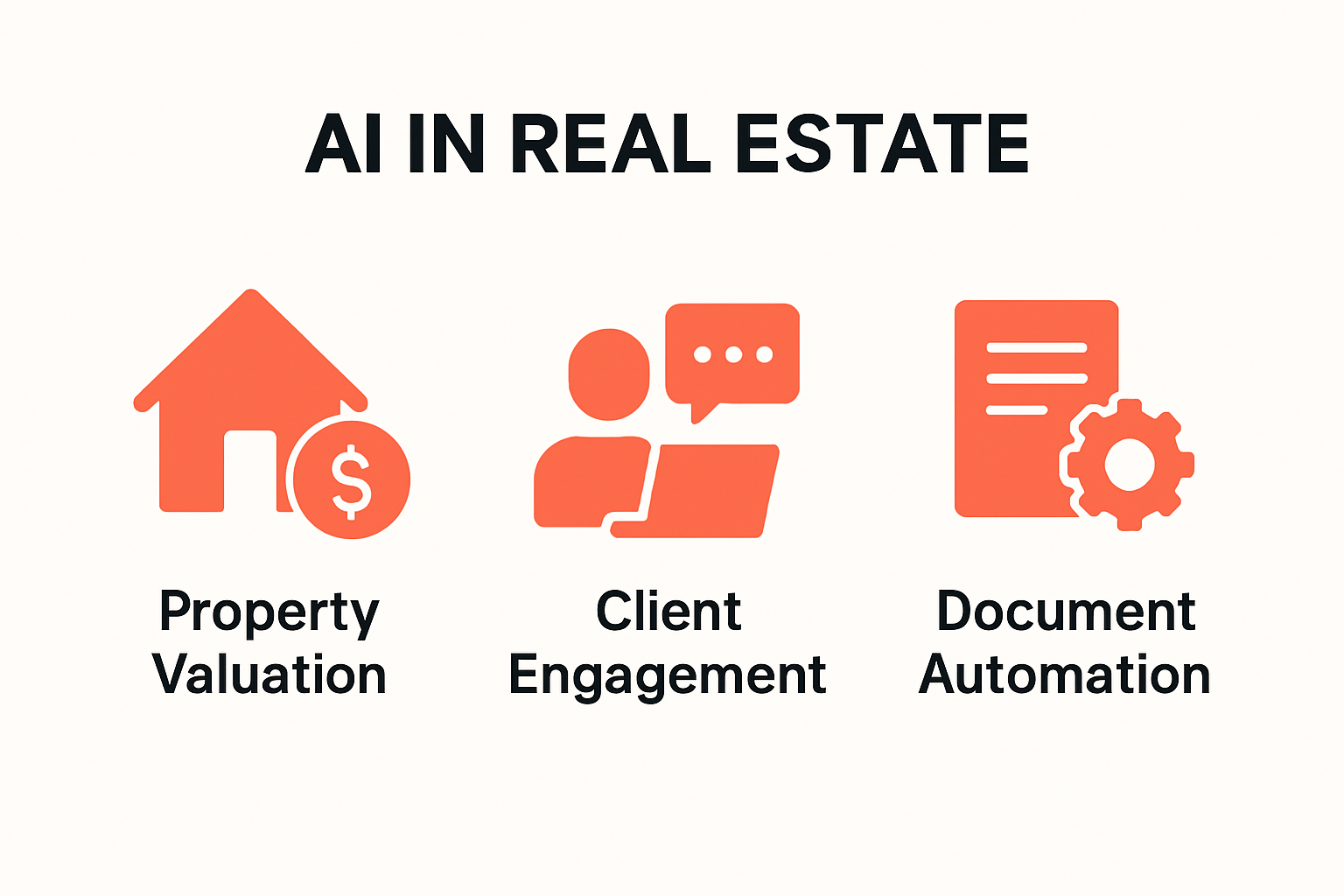
Artificial Intelligence in real estate represents a transformative technological approach that goes beyond simple automation. At its core, AI enables real estate professionals to process complex data, make intelligent predictions, and enhance decision making through advanced computational techniques.
The Fundamental Components of AI in Real Estate
AI in real estate is not a monolithic technology but a sophisticated ecosystem of interconnected analytical tools. According to research from Stanford University, these technologies typically include machine learning algorithms, natural language processing, computer vision, and predictive analytics. These systems can analyze vast datasets exponentially faster than human capabilities, uncovering insights that would be impossible through traditional methods.
The application of AI spans multiple critical domains in real estate. A systematic literature review indicates that AI methodologies can enhance property appraisal precision by up to 95% while simultaneously decreasing operating expenses by 20-30% through intelligent automation and predictive strategies.
To clarify the core technologies and benefits mentioned, here’s a table summarizing the fundamental components of AI in real estate and their primary purposes:
| AI Component | Purpose |
|---|---|
| Machine Learning Algorithms | Analyze large datasets, identify patterns |
| Natural Language Processing | Process and summarize legal documents |
| Computer Vision | Evaluate images, floor plans, and property visuals |
| Predictive Analytics | Forecast market trends and property valuations |
Advanced AI Applications in Property Valuation
One of the most compelling use cases for AI involves property valuation and market analysis. Cutting-edge research from arxiv.org demonstrates how self-supervised vision transformers can revolutionize property assessment. By integrating machine learning, computer vision, and advanced hedonic pricing models, these systems can generate remarkably accurate property value predictions with significantly lower root mean squared error compared to traditional appraisal techniques.
Interesting developments include deep learning techniques that analyze architectural elements. Research reveals that incorporating floor plan analysis into predictive models can reduce out-of-sample prediction errors by up to 10.56%. This means AI doesn’t just crunch numbers it comprehends visual and spatial information in ways that dramatically improve valuation accuracy.
For real estate professionals, understanding AI means recognizing it as a powerful analytical tool that augments human expertise. The technology does not replace agents but provides them with unprecedented insights, enabling more strategic decision making, precise market predictions, and enhanced client services.
The future of real estate lies in the symbiotic relationship between human intuition and artificial intelligence. Agents who embrace these technologies will be better equipped to navigate complex market dynamics, provide more personalized client experiences, and ultimately drive more successful outcomes in an increasingly data-driven industry.
As AI continues to evolve, real estate professionals must view it not as a distant technological concept but as an immediate, practical toolkit for improving operational efficiency, market understanding, and client engagement.
Key Benefits of AI for Real Estate Agents
AI technology is transforming the real estate industry by providing agents with powerful tools to enhance productivity, improve client experiences, and make more informed decisions. These technological advancements offer significant advantages that go far beyond traditional operational methods.
Intelligent Property Valuation and Market Analysis
AI introduces unprecedented precision in property valuation and market analysis. Research from TechTarget indicates that AI tools can process complex datasets rapidly, generating more accurate property value estimates. By analyzing historical trends, neighborhood characteristics, and comparative market data, these systems provide agents with nuanced insights that were previously impossible to obtain manually.
Predictive maintenance systems developed through AI technology allow agents to anticipate potential property issues before they become significant problems. This approach not only reduces repair costs but also enhances tenant satisfaction by proactively addressing maintenance concerns.

Enhanced Document Processing and Legal Efficiency
Document review represents another critical area where AI demonstrates remarkable capabilities. According to document processing research, AI tools can rapidly analyze extensive legal documents such as leases, contracts, and property records. These systems extract key information, summarize complex legal language, and identify potential risks or opportunities with remarkable accuracy.
By automating time-consuming administrative tasks, agents can redirect their energy towards building client relationships and closing deals. The efficiency gained through AI-powered document processing allows real estate professionals to handle more transactions with greater precision and reduced overhead.
Advanced Client Interaction and Personalization
AI technologies enable more sophisticated client engagement strategies. Machine learning algorithms can analyze client preferences, communication patterns, and historical interaction data to develop highly personalized communication approaches. Learn more about our AI assistant for real estate professionals to understand how technology can streamline client interactions.
These intelligent systems can predict client needs, recommend properties that match specific criteria, and even anticipate potential objections during negotiations. By providing agents with deep insights into client behavior, AI transforms the traditional approach to real estate sales and client management.
Real estate agents who embrace AI technologies position themselves at the forefront of industry innovation. The ability to leverage data-driven insights, automate routine tasks, and provide more personalized service represents a significant competitive advantage in an increasingly complex and dynamic market.
As AI continues to evolve, its role in real estate will become increasingly sophisticated. Agents who invest in understanding and implementing these technologies will be better equipped to deliver exceptional value to their clients, optimize their operational efficiency, and achieve superior business outcomes.
Top AI Tools and Applications in Real Estate
AI technologies are revolutionizing real estate through sophisticated tools that transform traditional operational approaches. These advanced applications provide real estate professionals with unprecedented capabilities to analyze data, engage clients, and optimize business processes.
Property Valuation and Market Analysis Tools
Forbes research highlights that AI-powered valuation models can analyze comprehensive datasets including property characteristics, market trends, and economic factors to generate more accurate property assessments. These tools leverage machine learning algorithms to provide nuanced insights that traditional valuation methods cannot achieve.
Advanced AI valuation platforms utilize computer vision and predictive analytics to assess property values with remarkable precision. By processing thousands of data points simultaneously, these tools can generate instantaneous market value estimates that account for micro-level neighborhood trends and emerging market dynamics.
To help readers understand how AI tools are impacting different parts of the real estate workflow, here’s a table summarizing major AI-powered applications and their key capabilities as described in the content:
| AI Application Area | Key Capabilities |
|---|---|
| Property Valuation & Market Analysis | High-accuracy appraisals, instant value estimates, trend forecasting |
| Lead Qualification & Client Engagement | Lead scoring, purchase probability prediction, personalized outreach |
| Predictive Maintenance & Property Management | Equipment failure anticipation, proactive scheduling, repair cost reduction |
| Visual Content Enhancement | Image optimization, auto-description, virtual staging, feature highlighting |
| Personalized Communication | Tailored messaging, timing optimization, automated follow-ups |
Lead Qualification and Client Engagement Solutions
AI solutions are transforming lead management through intelligent automation. According to industry research, these technologies analyze complex user behavior patterns and demographic data to identify high-potential property transaction candidates.
Intelligent lead qualification systems can:
- Automatically score and prioritize leads
- Predict client purchasing probability
- Generate personalized communication strategies
Explore our AI-powered lead management solution to understand how intelligent systems can streamline client interactions and improve conversion rates.
Predictive Maintenance and Property Management Applications
AI technologies are revolutionizing property management through predictive maintenance tools. A systematic literature review indicates that AI methodologies can decrease operating expenses by 20-30% through intelligent automation and predictive strategies.
These advanced systems utilize sensor data, historical maintenance records, and machine learning algorithms to:
- Anticipate potential equipment failures
- Schedule proactive maintenance
- Optimize resource allocation
- Reduce unexpected repair costs
Real estate professionals who integrate these AI tools position themselves at the forefront of technological innovation. By leveraging data-driven insights and intelligent automation, agents can dramatically improve operational efficiency, client satisfaction, and business performance.
As AI continues to evolve, these tools will become increasingly sophisticated, offering real estate professionals powerful capabilities to navigate complex market dynamics with greater precision and strategic insight. The future of real estate lies in embracing these intelligent technologies that transform raw data into actionable, valuable intelligence.
How AI Is Shaping Real Estate Marketing in 2025
Artificial Intelligence is fundamentally transforming real estate marketing strategies, offering unprecedented capabilities for targeted engagement, personalized communication, and data-driven campaign optimization. As we enter 2025, AI technologies are redefining how real estate professionals connect with potential clients and showcase properties.
Advanced Predictive Marketing Strategies
Research from industry analytics reveals that AI-driven predictive analytics can forecast housing price trends with approximately 92% accuracy. This extraordinary precision enables agents to anticipate market movements, develop targeted marketing campaigns, and provide clients with highly informed strategic insights.
By analyzing complex datasets including demographic information, online behavior, and historical transaction patterns, AI marketing tools can identify and segment potential buyers with remarkable granularity. These intelligent systems go beyond traditional demographic segmentation, creating nuanced buyer personas that reflect intricate behavioral and psychological characteristics.
AI-Enhanced Visual Content and Property Presentation
Visual content represents a critical domain where AI is driving significant innovation. According to industry research, AI-powered virtual tours have reduced property viewing times by 40%, dramatically enhancing client engagement and expediting decision-making processes.
AI image recognition systems are revolutionizing property listings. Emerging research indicates these technologies have increased listing views by 40% through automated content enhancement. These systems can:
- Automatically optimize image quality
- Generate compelling property descriptions
- Highlight unique architectural features
- Create immersive virtual staging experiences
Discover our AI-powered marketing solutions to understand how technology can transform your property presentations.
Personalized Communication and Lead Nurturing
AI is transforming client communication through intelligent, adaptive messaging strategies. Machine learning algorithms can analyze individual client interactions, preferences, and communication patterns to develop highly personalized engagement approaches.
These advanced systems enable real estate marketers to:
- Craft individualized email and messaging campaigns
- Predict optimal communication timing
- Recommend properties aligned with specific client preferences
- Automate follow-up sequences
By leveraging AI technologies, real estate marketing is becoming increasingly precise, responsive, and client-centric. Agents who embrace these innovations can differentiate themselves in a competitive market, offering potential clients a more sophisticated, data-driven approach to property discovery and transaction management.
The future of real estate marketing lies in the seamless integration of human expertise and artificial intelligence. As these technologies continue to evolve, they will provide increasingly powerful tools for understanding client needs, presenting properties more effectively, and creating more meaningful, personalized client experiences.
Frequently Asked Questions
What is AI in real estate?
AI in real estate refers to the use of artificial intelligence technologies to enhance processes such as property valuation, market analysis, and client engagement, enabling agents to make more informed and efficient decisions.
How does AI improve property valuation accuracy?
AI improves property valuation accuracy by utilizing machine learning algorithms and predictive analytics to assess vast datasets, leading to appraisals that can be up to 95% accurate compared to traditional methods.
What are key benefits of using AI for real estate agents?
The key benefits of using AI for real estate agents include enhanced property valuation, streamlined document processing, better client interaction through personalization, and predictive marketing capabilities that inform strategic decision-making.
Which AI tools are commonly used in real estate?
Common AI tools in real estate include property valuation platforms, lead qualification systems, predictive maintenance applications, and AI-powered marketing solutions that help agents optimize client engagement and operational efficiency.
Ready to Transform Lead Management with Real AI?
The article shows how AI is redefining real estate by boosting property valuations, streamlining document processing, and powering smarter client engagement. Yet, many agents still miss out on quality leads, slow down response times, and struggle to scale client communications even as advanced AI solutions become available. If this sounds familiar, you are not alone. Modern real estate demands immediate, personalized, and efficient lead handling to stay ahead. Imagine automating lead qualification, instant multi-channel replies, and seamless appointment bookings, all while lowering operational costs.

Step up and take action on what you have learned today. Find out how LeadLinker.co puts the most advanced AI tools in your hands to capture more business, never miss a hot lead, and free up valuable hours. See case studies and real examples from top agents at LeadLinker.co. Try the platform now to gain a true competitive edge in the AI-powered real estate landscape.