
Real estate pros are always hunting for that edge to turn more leads into loyal clients. But even with all the hype around networking events and social media ads, most agents still watch over 75 percent of their hard-earned leads slip away without a single follow-up. That surprises a lot of people, and not in a good way. The real shock? Top-producing agents are not just working harder—they are quietly using smarter workflows, laser-focused personalization, and tech tools that do the chasing for them.
Table of Contents
- Understanding The Lead Management Process
- Setting Up Efficient Lead Tracking Systems
- Personalizing Follow-Ups To Nurture Leads
- Leveraging Technology For Better Lead Conversion
Quick Summary
| Takeaway | Explanation |
|---|---|
| Implement a systematic lead management workflow | Create a structured process for tracking and nurturing leads from initial contact to conversion, ensuring no potential client is overlooked. |
| Utilize specialized technology for lead tracking | Select lead management platforms tailored for real estate that streamline data management, improve integration, and facilitate growth. |
| Personalize communication to nurture leads | Customize follow-up interactions based on lead segmentation to build trust and enhance conversion by addressing individual needs. |
| Adopt automated tracking and follow-up protocols | Establish predefined systems for lead scoring and automated reminders, ensuring timely engagement without manual effort. |
| Leverage machine learning for market insights | Use advanced algorithms to identify market trends and lead potential, optimizing decision-making and targeting strategies effectively. |
Understanding the Lead Management Process
Real estate professionals recognize that effective lead management is the backbone of sustainable business growth. The lead management process transforms raw inquiries into potential clients through a strategic approach that requires precision, technology, and consistent follow-up.
Defining the Lead Management Workflow
Lead management represents a comprehensive system for tracking potential clients from initial contact through conversion. Learn more about identifying real estate leads as the foundation of this critical process. According to research from CRM One, successful lead management involves several interconnected stages that demand meticulous attention.
The typical workflow includes multiple key phases:
Here is a breakdown of the typical lead management workflow phases in real estate. This process table helps visualize each stage and its purpose for easier understanding:
| Stage | Description |
|---|---|
| Lead Capture | Collecting contact information via online forms, social media, open houses, and referrals |
| Lead Qualification | Assessing readiness and likelihood of a client to make a transaction |
| Lead Nurturing | Building relationships through targeted, ongoing communication |
| Conversion | Turning qualified leads into actual clients |
- Lead Capture: Collecting contact information through various channels like website forms, social media, open houses, and referrals
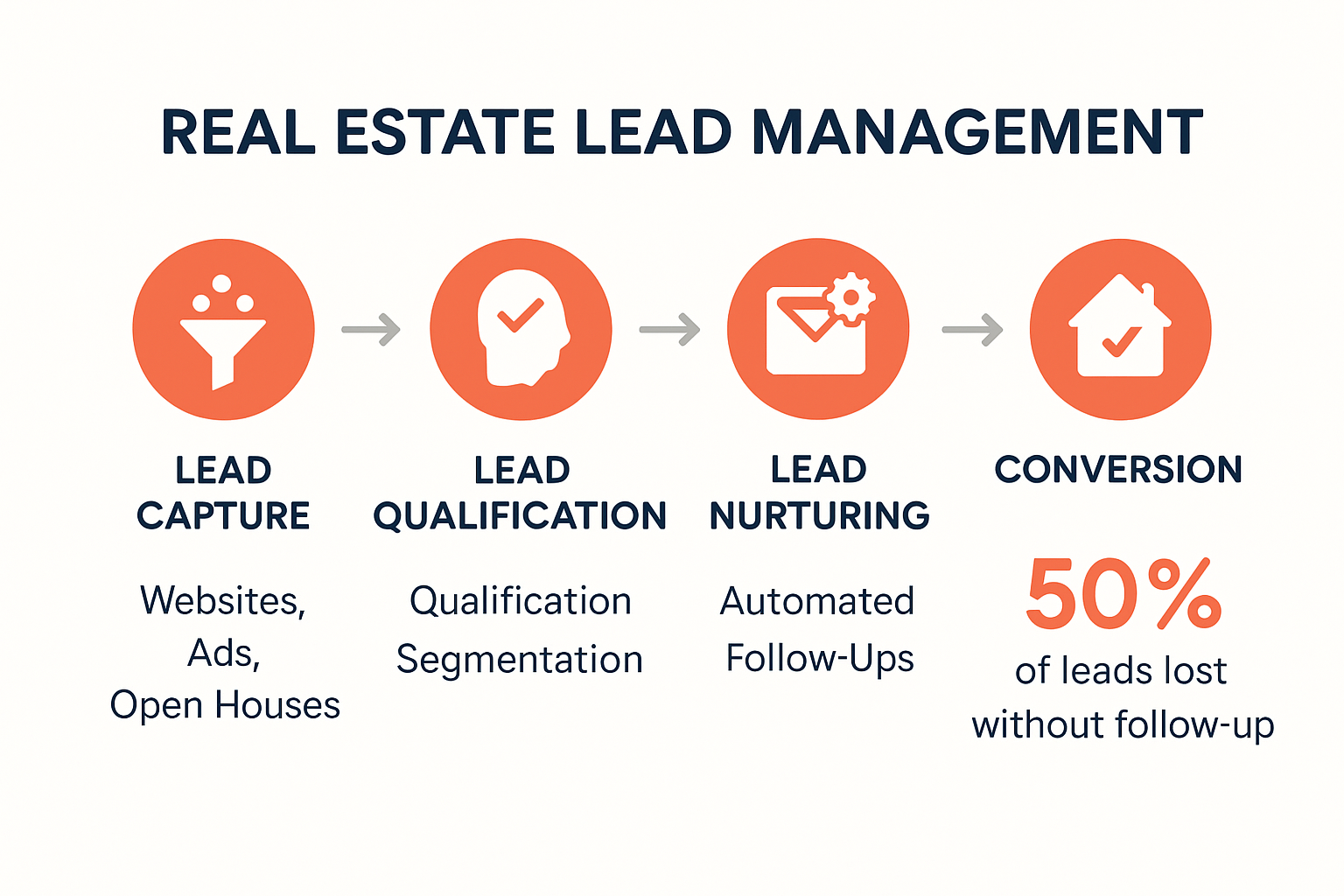
- Lead Qualification: Assessing potential client’s readiness and likelihood to transact
- Lead Nurturing: Developing relationships through targeted communication
- Conversion: Transforming qualified leads into actual clients
Data Management and Tracking
Accurate data management serves as the critical infrastructure of effective lead management. Sharp Launch research emphasizes that standardizing lead information minimizes errors and streamlines operational processes. Real estate professionals must establish robust systems that centralize lead information, track interactions, and provide clear visibility into each potential client’s journey.
Key data management practices include:
- Regular Data Audits: Ensuring contact information remains current and accurate
- Comprehensive Communication Logging: Recording all interactions and follow-ups
- Lead Stage Tracking: Monitoring progression through the sales pipeline
Strategic Communication and Follow-up
Successful lead management transcends mere data collection. According to Agent Legend’s strategic insights, the most effective approaches combine technological tools with personalized communication strategies. This means developing a systematic approach to responding to inquiries, segmenting leads based on their potential, and creating tailored communication plans that address individual client needs.
Effective lead management requires real estate professionals to balance technological efficiency with human touch, ensuring that each potential client feels valued and understood throughout their property journey.
Setting Up Efficient Lead Tracking Systems
In the dynamic world of real estate, setting up efficient lead tracking systems is not just a recommendation but a critical strategy for sustainable business growth. These systems transform raw lead data into actionable insights, enabling real estate professionals to optimize their conversion processes and maximize opportunities.
Choosing the Right Technology Infrastructure
Learn more about effective lead prioritization for your team. According to SharpLaunch research, selecting a specialized lead management platform tailored to real estate needs is crucial. Generic customer relationship management (CRM) systems often come with unnecessary complexity, whereas specialized solutions provide targeted features that streamline lead management.
Key considerations for technology selection include:
The following table summarizes key considerations when choosing technology solutions for real estate lead management. This summary helps agents identify what to prioritize when evaluating tools:
| Consideration | Why It Matters |
|---|---|
| Integration Capabilities | Allows seamless connection with existing tools and platforms |
| Customization Options | Ensures the CRM adapts to specific business workflows |
| Scalability | Supports future growth as your business expands |
-
Integration Capabilities: Ability to connect with existing tools and platforms
-
Customization Options: Flexibility to adapt to specific business workflows
-
Scalability: Potential to grow with your business needs
Implementing Systematic Data Collection
Property Raptor insights emphasize the importance of comprehensive data management. Efficient lead tracking systems require robust mechanisms for capturing, organizing, and analyzing lead information. This involves creating standardized entry points and automated data collection processes that minimize manual input and reduce potential errors.
Essential data collection strategies involve:
- Automated Lead Capture: Implementing web forms, chatbots, and integrated communication channels
- Comprehensive Contact Profiles: Gathering detailed information beyond basic contact details
- Real-time Data Synchronization: Ensuring immediate updates across all platforms
Developing Tracking and Follow-up Protocols
Sell.do research highlights the significance of establishing clear tracking and follow-up protocols. A systematic approach ensures no potential client falls through the cracks. This involves creating predefined workflows that automatically route leads, set reminders, and track interactions throughout the customer journey.
Effective tracking protocols should include:
- Lead Scoring Mechanisms: Quantifying lead potential and prioritizing high-value prospects
- Automated Communication Triggers: Sending timely and personalized follow-up messages
- Performance Analytics: Monitoring conversion rates and identifying improvement areas
By implementing these comprehensive lead tracking systems, real estate professionals can transform their approach from reactive to proactive. The goal is not just to manage leads but to create a seamless, intelligent process that converts potential clients into satisfied homeowners.
Personalizing Follow-Ups to Nurture Leads
Successful real estate lead nurturing goes far beyond generic communication. Personalization transforms routine follow-ups into meaningful interactions that build trust, demonstrate understanding, and increase the likelihood of conversion.
Understanding Lead Segmentation
Explore advanced lead conversion techniques that can revolutionize your approach. According to research from the Real-Estate RFME Model, effective lead nurturing requires sophisticated customer segmentation. By categorizing leads into distinct groups such as high-value prospects, promising potential clients, and those needing additional attention, real estate professionals can craft targeted communication strategies.
Key segmentation approaches include:
- Behavioral Tracking: Analyzing interaction patterns and property search history
- Demographic Profiling: Considering age, income, family status, and location preferences
- Engagement Level: Measuring responsiveness and interaction frequency
Crafting Personalized Communication Strategies
Research on email optimization reveals that personalized communication can dramatically improve response rates. The study demonstrates that tailored recommendations can increase conversion rates by up to 50% while reducing communication volume. This approach requires a nuanced understanding of each lead’s unique needs and preferences.
Effective personalization strategies involve:
- Contextual Messaging: Addressing specific property interests and requirements
- Timing Optimization: Sending communications at most receptive moments
- Channel Preference: Utilizing leads’ preferred communication methods
Implementing Adaptive Follow-Up Techniques
Learn more about lead nurturing strategies to enhance your approach. Successful follow-up requires a dynamic and responsive system that adapts to each lead’s evolving needs. This means creating multi-channel communication pathways that provide value at every interaction point.
Key adaptive follow-up techniques include:
- Progressive Profiling: Gradually collecting more detailed information
- Automated Yet Personal Touchpoints: Using AI-driven personalization
- Contextual Content Delivery: Sharing relevant market insights and property recommendations
Personalization is not about overwhelming leads with information but about demonstrating genuine understanding and commitment. By treating each potential client as a unique individual with specific goals and challenges, real estate professionals can transform standard follow-ups into meaningful relationship-building opportunities that significantly improve conversion rates.

Leveraging Technology for Better Lead Conversion
In today’s competitive real estate market, technology has become an indispensable tool for transforming lead conversion strategies. By integrating advanced technological solutions, real estate professionals can dramatically enhance their ability to identify, engage, and convert potential clients more effectively and efficiently.
Intelligent Property Recommendation Systems
Discover advanced lead conversion techniques that leverage cutting-edge technology. According to research on RE-RecSys, intelligent recommendation systems are revolutionizing how real estate professionals match potential clients with properties. These sophisticated systems analyze user interaction histories, combining content and collaborative filtering approaches to provide highly personalized property suggestions that significantly increase the likelihood of conversion.
Key technological capabilities include:
- Behavioral Pattern Analysis: Tracking and interpreting user search and interaction patterns
- Predictive Matching: Utilizing machine learning to suggest most relevant properties
- Dynamic Recommendation Refinement: Continuously improving suggestions based on user feedback
Advanced Image and Property Assessment Technologies
Research on deep learning applications reveals groundbreaking approaches to property evaluation. Innovative technologies now enable more comprehensive property assessments through advanced visual analysis. For instance, deep learning techniques can assess property images using features like ‘Damage Level,’ providing potential buyers with more transparent and detailed property insights.
Technological assessment strategies encompass:
- Visual Condition Evaluation: Analyzing property images for structural and aesthetic details
- Automated Condition Reporting: Generating comprehensive property condition assessments
- Comparative Market Analysis: Utilizing AI to provide real-time market value comparisons
Machine Learning for Market Opportunity Identification
Research on real estate machine learning applications demonstrates the potential of predictive technologies in lead conversion. Machine learning algorithms can now estimate market prices, identify undervalued properties, and provide strategic insights that enable real estate professionals to target the most promising leads with unprecedented precision.
Advanced machine learning techniques offer:
- Price Estimation Algorithms: Accurately predicting property values
- Market Trend Analysis: Identifying emerging real estate opportunities
- Lead Potential Scoring: Quantifying the likelihood of successful conversion
Technology is not replacing human expertise but augmenting it. By embracing these intelligent solutions, real estate professionals can create more targeted, efficient, and personalized lead conversion strategies. The future of real estate lead management lies in the seamless integration of human insight and technological innovation, enabling professionals to work smarter, not just harder.
The key is to view technology as a collaborative tool that enhances human capabilities, providing deeper insights, more efficient processes, and ultimately, more meaningful connections with potential clients.
Frequently Asked Questions
What is lead management in real estate?
Lead management in real estate refers to the structured process of capturing, tracking, nurturing, and converting potential clients into actual sales. This involves using various tools and techniques to ensure that no lead is overlooked and that each interaction is meaningful.
Why is follow-up important in lead management?
Follow-up is critical in lead management because it helps build relationships with potential clients, keeps them engaged, and addresses their needs. Consistent communication ensures that leads feel valued and increases the likelihood of conversion into loyal clients.
How can technology improve lead management in real estate?
Technology can streamline lead management through specialized platforms that automate data collection, enhance communication tracking, and provide valuable insights through analytics. Utilizing tools like CRM systems can help real estate professionals engage effectively with leads and maintain organized databases.
What are some best practices for personalizing communication with leads?
Best practices for personalizing communication include segmenting leads based on their needs and preferences, sending targeted messages at optimal times, and utilizing preferred communication channels. Personal interactions tailored to individual interests can significantly improve engagement and conversion rates.
Stop Letting Hot Leads Slip Away: Take Control with AI-Driven Lead Management
Are you frustrated by missed opportunities and overwhelmed by the pressure of chasing up every new real estate inquiry? Like the article explains, most agents lose over 75 percent of their leads simply because they lack a consistent management system and fast response times. When every minute counts, relying only on manual follow-up is a costly risk. Explore the foundation of lead management and see how top performers build their pipeline on smarter processes and tech.

Turn knowledge into action today. Visit LeadLinker.co to see how our AI assistant transforms your workflow. Our platform automatically responds to every inquiry 24/7 across SMS, email, and social media. You get increased appointment bookings, instant lead qualification, and integration with your existing CRM without the need to hire extra staff. Start building a more efficient real estate business today and never let a high-value lead slip past you again.