
Real estate and technology are colliding faster than ever. Agents are watching as new innovations like blockchain and AI disrupt every corner of the industry. But what really stands out is that over 80 percent of agents now use AI-driven tools for property valuations and lead management, and that number is only climbing. Most think fancy 3D tours or smart contracts are just bells and whistles. The real surprise is that these digital upgrades are quietly changing who succeeds in real estate and who gets left behind.
Table of Contents
- Proptech Innovations Transforming Real Estate
- AI And Automation In Real Estate Operations
- Virtual Reality And 3D Tours For Listings
- Data Analytics And Smart Marketing Strategies
Quick Summary
| Takeaway | Explanation |
|---|---|
| Embrace Blockchain for Transparency | Blockchain technology enhances transparency in transactions, reducing fraud risks and allowing fractional ownership. Real estate agents should leverage this tech to build trust. |
| Utilize AI for Precise Valuations | AI tools facilitate accurate property valuations by analyzing diverse data quickly, allowing agents to provide reliable pricing strategies to clients. |
| Adopt Smart Contracts for Efficiency | Smart contracts automate key tasks like rent collection, streamlining management processes and improving tenant-lender relations for agents and property managers. |
| Leverage Virtual Reality for Listings | Virtual tours and 3D experiences offer immersive property visualization, aiding buyers’ engagement and expanding reach for agents, particularly for out-of-town clients. |
| Implement Predictive Analytics for Targeting | Predictive models analyze client behavior, enabling targeted marketing efforts that resonate with individual needs, thereby boosting conversion rates and efficiency. |
Proptech Innovations Transforming Real Estate
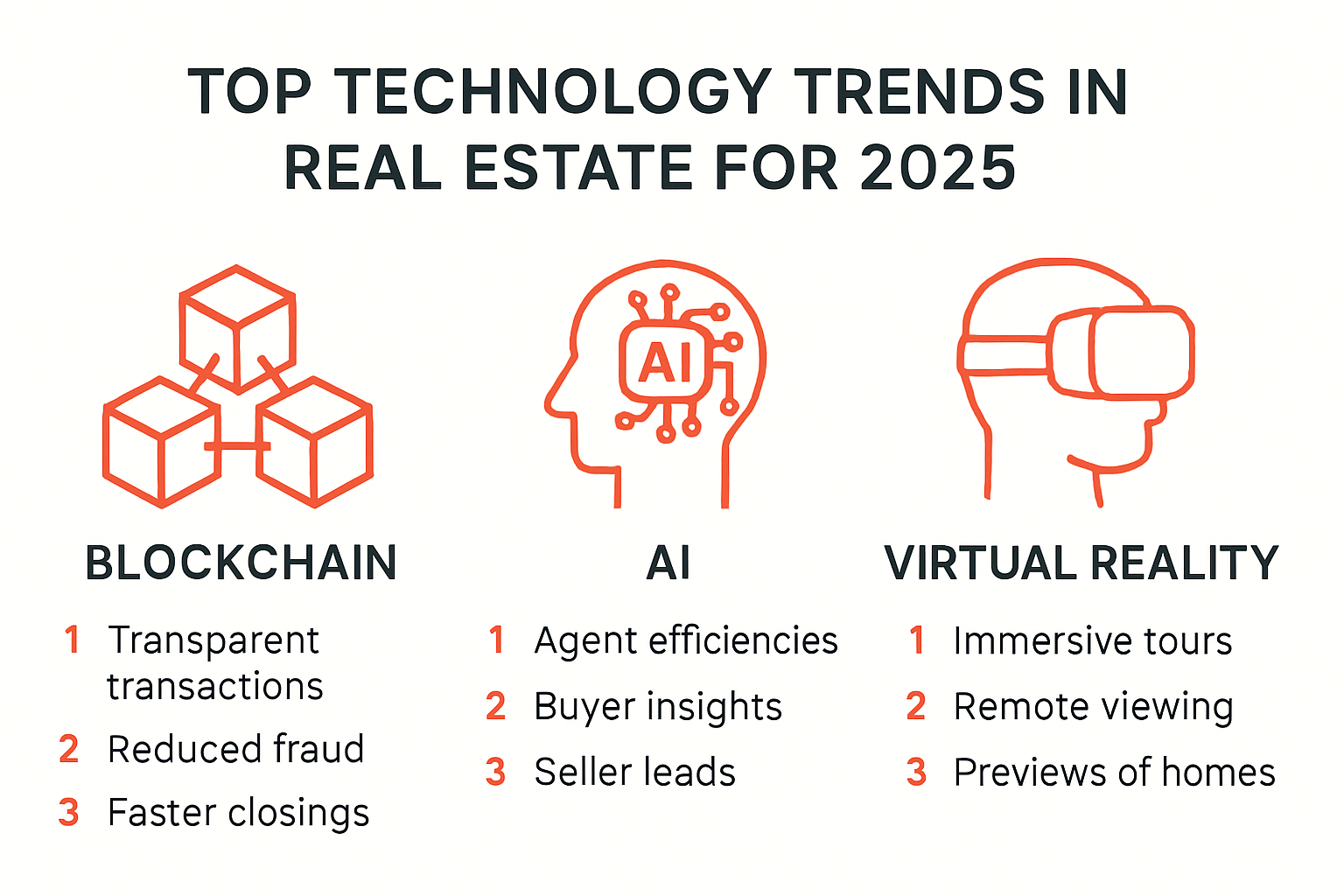
Tech trends in real estate are rapidly evolving, with proptech driving unprecedented transformation across the industry. Real estate professionals now face a technological revolution that promises to reshape how properties are bought, sold, managed, and valued.
Blockchain Revolutionizing Property Transactions
Blockchain technology is emerging as a game-changing innovation in real estate. Researchers exploring blockchain applications reveal how this technology can fundamentally transform property transactions. The key advantage lies in tokenization, which introduces unprecedented levels of transparency and reduces potential fraud risks.
Tokenization allows property assets to be divided into digital shares, enabling fractional ownership and increasing market liquidity. This means investors can now purchase smaller portions of high-value real estate assets, democratizing investment opportunities that were previously accessible only to wealthy individuals.
Moreover, blockchain creates immutable transaction records, ensuring that every property transfer is permanently documented and verifiable. Real estate agents can leverage this technology to provide clients with enhanced trust and security during complex property transactions.
AI-Powered Property Valuation and Management
Artificial intelligence is making significant inroads into real estate valuation and management processes. Advanced research on Large Language Models demonstrates how AI can revolutionize property appraisals by processing vast amounts of data with remarkable accuracy.
These AI systems can analyze multiple factors simultaneously, including historical price trends, neighborhood demographics, property conditions, and market dynamics. By doing so, they generate more precise property valuations faster than traditional human-driven methods. Real estate agents can utilize these AI tools to provide clients with more reliable and data-driven pricing strategies.
The implications extend beyond valuation. AI-powered platforms can automate routine tasks like lease management, maintenance scheduling, and tenant communication. This automation reduces administrative burdens and allows real estate professionals to focus on high-value strategic activities.
Smart Contracts and Automated Property Management
Blockchain oracles are introducing innovative solutions for rental property management. Research proposals demonstrate how smart contracts can automate critical processes like rent collection and maintenance requests.
These smart contracts create programmable agreements that execute automatically when predefined conditions are met. For instance, rent payments can be automatically processed on specific dates, and maintenance requests can be instantly routed to appropriate service providers based on predefined criteria.
Real estate agents and property managers can benefit from reduced administrative overhead, improved transparency, and enhanced tenant-landlord relationships. By implementing these technological innovations, professionals can streamline operations and provide more efficient, responsive services.
For agents looking to dive deeper into how AI is transforming the real estate landscape, check out our comprehensive guide on AI tools and trends.
As proptech continues to evolve, real estate professionals who embrace these technological innovations will position themselves at the forefront of an increasingly digital and data-driven industry.
To help you quickly compare the key features of emerging proptech solutions, here’s a summary table:
| Technology | Key Benefit | Processes Impacted |
|---|---|---|
| Blockchain & Tokenization | Transparency, Fractional Ownership | Property transactions, investment access |
| Smart Contracts | Automated Execution, Security | Rent collection, maintenance requests |
| AI-Powered Valuation | Accuracy, Speed | Property valuation, pricing strategies |
| Automation Tools | Efficiency, Lower Admin Burden | Lease management, tenant communication |
AI and Automation in Real Estate Operations

The real estate industry is experiencing a profound transformation through artificial intelligence and automation technologies. These cutting-edge solutions are revolutionizing how agents operate, communicate with clients, and manage complex business processes.
Intelligent Lead Management and Client Engagement
According to the National Association of Realtors, AI-driven tools are dramatically reshaping lead generation and client interactions. Intelligent virtual assistants now enable real estate professionals to provide 24/7 responsive communication, ensuring no potential client inquiry goes unanswered.
These AI systems can instantly qualify leads by asking strategic questions, understanding client preferences, and routing inquiries to the most appropriate agent. Machine learning algorithms analyze past interactions to predict client needs, allowing agents to personalize their approach and increase conversion rates.
Automated communication platforms can now send personalized follow-up messages, schedule appointments, and even handle initial objection handling. This means agents spend less time on administrative tasks and more time on high-value relationship building and negotiation.
Predictive Analytics and Property Valuation
Advanced machine learning models are transforming property valuation and market prediction. These sophisticated algorithms can analyze thousands of data points simultaneously, including historical sales data, neighborhood trends, economic indicators, and property characteristics.
Real estate professionals can now access incredibly precise property valuations and market forecasts. AI-powered tools provide instant comparables, predict potential appreciation rates, and identify emerging market opportunities with unprecedented accuracy. This data-driven approach enables agents to offer more strategic advice to buyers and sellers.
Predictive analytics also help agents anticipate market shifts, understand buyer behavior, and develop more targeted marketing strategies. By leveraging these insights, real estate professionals can stay ahead of market trends and make more informed investment recommendations.
Workflow Automation and Operational Efficiency
Automation technologies are streamlining complex operational workflows in real estate. From document management to transaction tracking, AI-powered platforms reduce administrative overhead and minimize human error.
Smart contract management systems can automatically generate, review, and process legal documents. Automated scheduling tools synchronize calendars, book appointments, and send reminders. Machine learning algorithms can even predict potential transaction bottlenecks and suggest proactive solutions.
For agents looking to understand how these technologies can transform their business, explore our comprehensive AI integration guide.
As AI and automation continue to evolve, real estate professionals who embrace these technologies will gain significant competitive advantages. By combining human expertise with intelligent technological solutions, agents can deliver more personalized, efficient, and data-driven services to their clients.
Virtual Reality and 3D Tours for Listings
Virtual reality and 3D tour technologies are revolutionizing property showcasing, offering real estate agents unprecedented tools to engage potential buyers and transform the traditional property viewing experience.
Immersive Property Visualization Technologies
Researchers developing advanced visualization pipelines are creating innovative methods for generating comprehensive virtual property tours. These technologies enable agents to produce highly detailed, interactive digital representations of properties that go far beyond traditional photography.
The newest 3D tour technologies leverage equirectangular imaging techniques, allowing potential buyers to navigate properties remotely with extraordinary precision. By implementing sophisticated HSV-based coloring schemes, these virtual tours provide near-realistic representations of interior spaces, enabling clients to experience properties as if they were physically present.
These immersive experiences are particularly valuable for out-of-town buyers, international investors, and clients with limited mobility. Virtual tours eliminate geographical barriers, allowing instantaneous property exploration without time-consuming physical travel.
Augmented Reality in Property Design and Staging
Building Information Modeling research reveals how augmented reality is transforming property visualization and design processes. Real estate professionals can now use AR technologies to demonstrate potential renovations, furniture placements, and design modifications in real-time.
Augmented reality tools allow clients to visualize empty spaces with potential furniture layouts, wall color changes, and architectural modifications. This technology helps buyers understand a property’s true potential, making decision-making more intuitive and engaging.
For investors and homebuyers, AR provides a powerful imagination catalyst. Instead of relying on static floor plans or limited imagination, clients can now see exactly how a space might look after personalization or renovation.
Personalized Virtual Space Experiences
Innovative frameworks like MetaDecorator are pushing virtual tour technologies into entirely new territories. These advanced systems enable text-driven personalization of virtual spaces, allowing potential buyers to experiment with different design styles and configurations.
By leveraging image synthesis techniques, these platforms can transform standard property panoramas into uniquely styled environments. Clients can now instantly visualize how a space might look with different design aesthetics, from minimalist modern to classic traditional, all through intuitive digital interfaces.
This technology represents a significant leap in property marketing, providing emotional connections and personalized experiences that static images could never achieve. Real estate agents can now offer interactive, customizable property explorations that engage clients on a deeper level.
Discover how our platform integrates cutting-edge visualization technologies to help agents stay ahead in an increasingly digital marketplace.
As virtual reality and 3D tour technologies continue evolving, they are not just supplementary tools but becoming essential components of modern real estate marketing strategies. Agents who embrace these technologies will differentiate themselves, providing clients with more engaging, informative, and immersive property exploration experiences.
To clarify the different visualization technologies and their benefits for agents and clients, here’s a quick comparison table:
| Technology | Use Case/Function | Main Benefits |
|---|---|---|
| 3D Virtual Tours | Remote property exploration | Immersive viewing, wider reach, convenience |
| Equirectangular Imaging | Detailed property navigation | Realistic, interactive, precise visualization |
| Augmented Reality | Staging, renovation visualization | Real-time design changes, supports imagination |
| MetaDecorator | Text-driven personalized virtual spaces | Custom design previews, emotional engagement |
Data Analytics and Smart Marketing Strategies
Data analytics has emerged as a transformative force in real estate marketing, enabling agents to develop more targeted, efficient, and personalized strategies that significantly enhance client engagement and conversion rates.
Predictive Client Behavior Modeling
Advanced data analytics platforms now allow real estate professionals to move beyond traditional marketing approaches by creating sophisticated predictive models of client behavior. These intelligent systems analyze multiple data points, including online search patterns, social media interactions, demographic information, and past transaction histories to generate incredibly precise client profiles.
By understanding potential buyers and sellers at a granular level, agents can craft hyper-personalized marketing campaigns that speak directly to individual client needs and preferences. Machine learning algorithms can predict not just who might be interested in a property, but when they are most likely to make a purchase, what specific features they value most, and which communication channels will be most effective.
These predictive models enable agents to prioritize leads more effectively, allocating their time and resources toward prospects with the highest probability of conversion. This data-driven approach transforms marketing from a broad, generalized strategy to a precise, targeted engagement mechanism.
Multichannel Marketing Intelligence
According to the National Association of Realtors research, modern real estate marketing requires a sophisticated multichannel approach that integrates digital and traditional marketing strategies. Data analytics tools now provide comprehensive insights across platforms, allowing agents to track and optimize their marketing efforts in real-time.
Intelligent marketing platforms can analyze performance metrics across social media, email campaigns, digital advertisements, and traditional marketing channels. These systems provide granular insights into which marketing strategies generate the most engagement, track conversion rates, and help agents understand the return on investment for each marketing initiative.
By leveraging these multichannel analytics, real estate professionals can create more agile and responsive marketing strategies. Agents can quickly adjust their approaches based on data-driven insights, ensuring that their marketing efforts remain efficient and effective in a rapidly changing market.
Personalized Content and Targeted Advertising
Data analytics has revolutionized content creation and advertising strategies in real estate. Advanced algorithms can now generate personalized content recommendations, email campaigns, and advertising targeting that feels uniquely tailored to individual potential clients.
Machine learning models analyze user interaction data to understand preferences, creating dynamic content that adapts in real-time. For instance, a potential buyer interested in modern downtown condos will receive different marketing materials compared to someone searching for suburban family homes. This level of personalization dramatically increases engagement and conversion potential.
Learn how our platform revolutionizes lead nurturing through smart analytics, helping agents transform raw data into meaningful client connections.
As data analytics technologies continue to evolve, real estate professionals who embrace these intelligent marketing strategies will gain significant competitive advantages. By combining human intuition with powerful analytical tools, agents can create more meaningful, effective, and personalized marketing experiences that resonate with modern clients.
Frequently Asked Questions
What are the top tech trends real estate agents should know for 2025?
The top tech trends include blockchain technology for transparency, AI tools for accurate property valuations, smart contracts for efficiency, virtual reality for immersive property tours, and data analytics for targeted marketing strategies.
How does blockchain technology benefit real estate transactions?
Blockchain enhances transparency in transactions, reduces fraud risks, and allows for fractional ownership, making it easier for more investors to participate in the real estate market.
What advantages does AI offer in real estate valuation?
AI offers precise property valuations by analyzing a variety of data points rapidly, which helps agents give reliable pricing strategies to their clients, ultimately improving decision-making.
Why are virtual reality and 3D tours important for real estate agents?
Virtual reality and 3D tours provide immersive property visualization, allowing potential buyers to explore properties remotely, which is particularly beneficial for out-of-town clients and improves engagement.
Ready to Capture More Leads With the Latest in Real Estate Tech?
Agents reading about automation, AI, and immersive digital experiences often feel pressure to keep up, but real pain comes when great leads fall through the cracks or slow responses drive prospects elsewhere. The article highlights how vital it is to adopt predictive analytics and round-the-clock communication to stay competitive in 2025. Missing just one message can mean missing out on thousands in commissions or watching competitors win your most promising leads. Now there is a proven way to match the tech trends transforming real estate without hiring more staff or juggling complicated tools.

If you are eager to bridge the gap between modern industry trends and your daily business, let LeadLinker.co’s AI-powered platform become your advantage. Our tools help you automate lead qualification, instantly reply to prospects across all channels and schedule appointments without missing a beat. See real case studies and testimonials from top-performing agents who are already turning missed opportunities into measurable results by visiting LeadLinker.co today. Take the next step to ensure you never lose another lead to slow response times. Sign up now to future-proof your business with innovations designed for the digital age.