
Real estate prices always seem to fluctuate and every professional wonders what comes next. Yet only a few realize that most property cycles share four repeating stages recognized by over 85 percent of industry experts. Here is the twist. Those who truly understand these cycles do not just survive market ups and downs, they strategically grow their business no matter the phase.
Table of Contents
- What Are Real Estate Market Cycles?
- The Four Phases of the Real Estate Cycle
- How Agents and Brokers Can Adapt Strategies
- Using Market Cycle Insights for Better Marketing
Quick Summary
| Takeaway | Explanation |
|---|---|
| Understand Market Phases | Recognize the four phases: Recovery, Expansion, Hyper Supply, and Recession. These phases dictate real estate trends and investment strategies. |
| Monitor Economic Indicators | Track key indicators like interest rates and employment rates to foresee market shifts and make informed decisions. |
| Adapt Marketing Strategies | Tailor marketing messages based on market phases to effectively communicate opportunities and challenges to clients. |
| Leverage Data Analytics | Utilize data analytics for predictive modeling; analyze inventory levels, price trends, and demographic shifts for strategic insights. |
| Diversify Investment Portfolio | Explore different market segments and geographic areas to mitigate risks during market fluctuations and capitalize on emerging opportunities. |
What Are Real Estate Market Cycles?
Real estate market cycles represent the predictable patterns of fluctuation in property values, investment opportunities, and market dynamics that professionals experience over time. These cycles are complex economic phenomena that impact how real estate agents, investors, and brokers make strategic decisions about property transactions and investments.
The Fundamental Stages of Market Cycles
Real estate market cycles typically progress through four distinct stages: expansion, peak, contraction, and trough. Understanding these stages is crucial for professionals seeking to navigate the complex landscape of property investments and transactions. Research from the Urban Land Institute indicates that these cycles are not random but follow recognizable economic patterns driven by multiple interconnected factors.
Expansion Stage: During this phase, the real estate market experiences growth characterized by increasing property values, rising demand, and robust economic conditions. Investors see rising rental rates, lower vacancy rates, and significant construction activity. According to the National Association of Realtors, expansion typically occurs when employment rates are high, consumer confidence is strong, and economic indicators suggest positive momentum.
Peak Stage: The peak represents the pinnacle of market performance, where property values reach their maximum potential before transitioning into a potential downturn. At this stage, real estate professionals observe signs of market saturation, with prices potentially becoming disconnected from fundamental economic values. Investment opportunities become more selective, and market entry becomes increasingly challenging.
Economic Indicators Driving Market Cycles
Multiple economic indicators contribute to the progression of real estate market cycles. These include employment rates, interest rates, population growth, infrastructure development, and broader macroeconomic trends. Understanding these indicators allows real estate professionals to anticipate market shifts and make informed strategic decisions.
The table below organizes major economic indicators that drive real estate market cycles and explains their influence. This provides a quick reference to help professionals track factors impacting property market dynamics.
| Economic Indicator | Influence on Market Cycle |
|---|---|
| Interest Rates | Affects borrowing costs and overall investment attractiveness |
| Employment Trends | Drives housing demand through job stability and growth |
| Population Demographics | Creates localized market demand based on migration and shifts |
| Infrastructure Development | Encourages growth and impacts property values |
| Macroeconomic Trends | Sets broad market direction and investor sentiment |
Key economic factors influencing real estate market cycles include:
- Interest Rates: Central bank monetary policies directly impact borrowing costs and investment attractiveness
- Employment Trends: Job market stability and growth significantly influence housing demand
- Population Demographics: Migration patterns and population shifts create localized market dynamics
Professionals who monitor market trends closely can develop more nuanced strategies for navigating these complex cycles. By recognizing early indicators and understanding the underlying economic mechanisms, real estate agents can position themselves to make more intelligent investment and transaction decisions.
Market cycles are not uniform across all regions or property types. Commercial real estate, residential properties, and different geographic markets may experience unique variations in their cyclical patterns. Successful real estate professionals develop a sophisticated understanding of these nuanced dynamics, allowing them to adapt their strategies according to specific market conditions.
Continuous learning and staying informed about economic trends remain essential for professionals seeking to excel in the dynamic world of real estate market cycles.
The Four Phases of the Real Estate Cycle
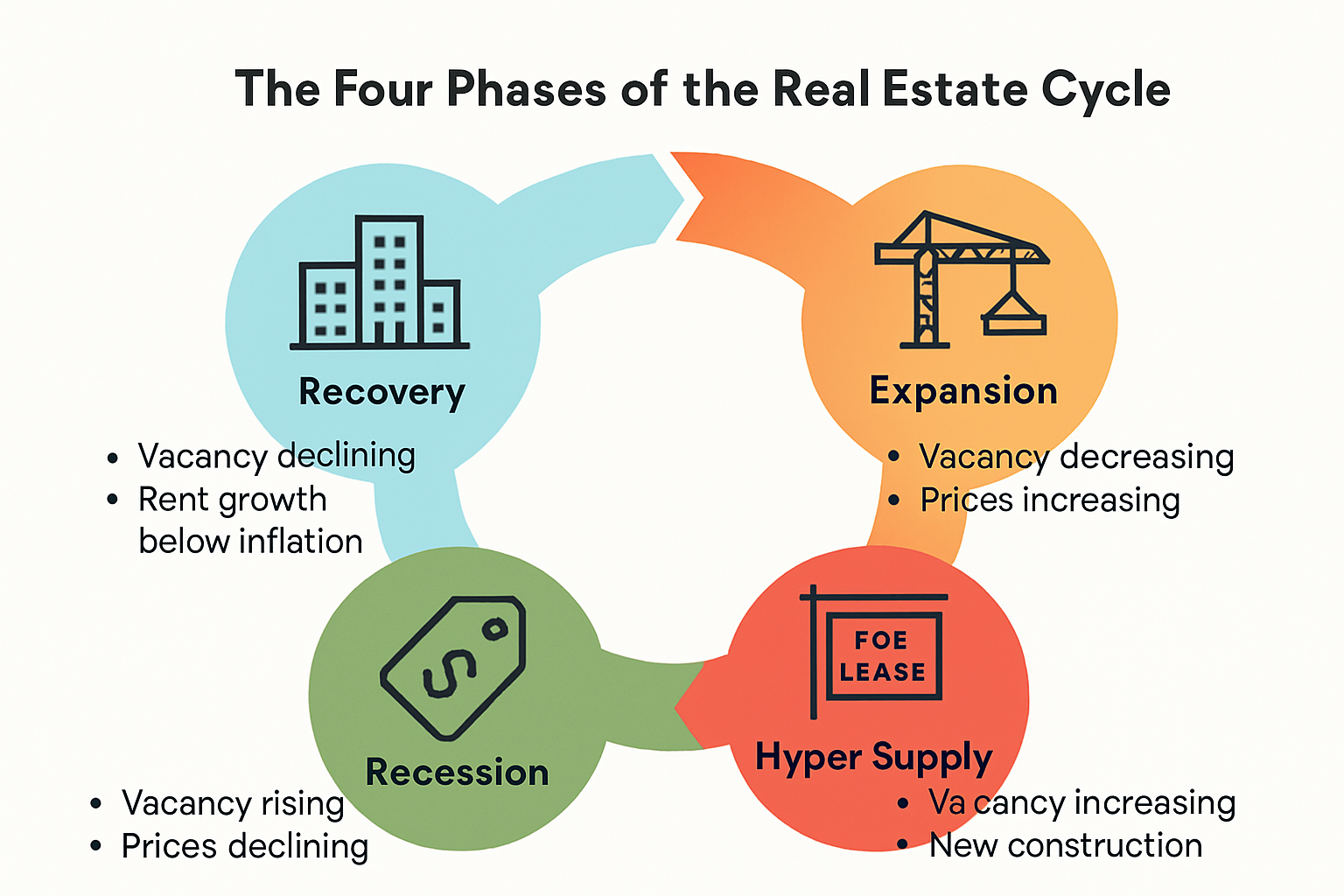
The real estate market cycle is a dynamic process characterized by four interconnected phases that represent the natural progression of property markets. Understanding these phases enables real estate professionals to make strategic decisions, anticipate market shifts, and optimize investment opportunities.
Below is a summary table outlining the key characteristics of each phase in the real estate market cycle. This table helps professionals quickly identify major features and warning signs at each stage.
| Phase | Key Characteristics |
|---|---|
| Recovery | Low vacancy rates, limited new development, gradual price stabilization |
| Expansion | Increased construction, rising property values, strong rental markets |
| Hyper Supply | Excessive new construction, increasing vacancy rates, slowing appreciation |
| Recession | Declining property values, limited investment activity, increased vacancy rates |
Recovery Phase: Rebuilding Market Momentum
The recovery phase marks the initial stage of market regeneration after a significant downturn. During this period, research from the Urban Land Institute indicates that property values stabilize and begin to show subtle signs of improvement. Vacancy rates start decreasing, and investor confidence gradually returns. Real estate professionals observe minimal new construction activity, with existing properties experiencing slow but steady appreciation.
Key characteristics of the recovery phase include:
- Low Vacancy Rates: Existing properties become more attractive as market demand incrementally increases
- Limited New Development: Cautious investment approach with minimal new construction projects
- Gradual Price Stabilization: Property values begin to find their baseline after previous market corrections
Expansion Phase: Accelerated Market Growth
The expansion phase represents a period of robust market growth and increasing investor enthusiasm. According to the National Association of Realtors, this phase is characterized by rising property values, increased construction activity, and strong economic fundamentals. Real estate professionals experience heightened demand, with rental rates and property prices showing consistent upward trajectories.
During the expansion phase, market participants witness:
- Increased Construction: Developers launch new projects in response to growing market demand
- Rising Property Values: Consistent appreciation of real estate assets
- Strong Rental Markets: Higher occupancy rates and increasing rental income potential
Hyper Supply Phase: Market Saturation
The hyper supply phase emerges when market supply begins to outpace demand. Professionals who monitor market trends closely recognize this stage through increasing vacancy rates and slowing absorption of new properties. Construction momentum continues, but market absorption rates decline, signaling potential market imbalances.
Indicators of the hyper supply phase include:
- Excessive New Construction: Development projects exceeding current market absorption capabilities
- Increasing Vacancy Rates: Reduced demand relative to available property inventory
- Slowing Appreciation: Diminishing property value growth rates
Recession Phase: Market Correction
The recession phase represents a significant market downturn characterized by declining property values, reduced investor confidence, and economic challenges. During this stage, real estate professionals must adapt their strategies to navigate reduced market activity and potential financial pressures.
Recession phase characteristics typically include:
- Declining Property Values: Significant reductions in real estate asset prices
- Limited Investment Activity: Reduced transaction volumes and cautious investor behavior
- Increased Vacancy Rates: Challenges in maintaining property occupancy
Successful real estate professionals understand that these phases are cyclical and interconnected. By developing a nuanced understanding of market dynamics, agents can anticipate shifts, adjust strategies, and identify emerging opportunities across different market conditions.
Continuous education, market research, and adaptability remain crucial for navigating the complex landscape of real estate market cycles.
How Agents and Brokers Can Adapt Strategies
Navigating real estate market cycles requires strategic adaptability and proactive decision making. Real estate professionals must develop nuanced approaches that respond dynamically to changing market conditions, ensuring continued success and client satisfaction across different economic environments.
Data Driven Decision Making
Research from the National Association of Realtors highlights the critical importance of data analytics in strategic market adaptation. Successful agents leverage sophisticated market intelligence to anticipate shifts and design responsive business strategies. This approach involves continuously monitoring key economic indicators, tracking local market trends, and developing predictive models that inform investment and sales decisions.
Key data points professionals should track include:
- Inventory Levels: Current property availability and absorption rates
- Price Trends: Median property values and rate of appreciation or depreciation
- Days on Market: Average time properties remain listed before sale
- Demographic Shifts: Population migration patterns and local economic development
Strategic Marketing and Client Communication
Effective communication becomes paramount during market transitions. Agents who refine their marketing approaches can maintain client confidence and generate opportunities across different market phases. This requires developing flexible messaging that addresses client concerns and highlights potential opportunities inherent in current market conditions.
Strategic communication tactics include:

- Educational Content: Providing clients with transparent market insights
- Personalized Consultations: Tailoring advice to individual client investment goals
- Multichannel Engagement: Utilizing digital platforms to maintain consistent client connections
Portfolio Diversification and Risk Management
According to market research from Zillow, successful real estate professionals understand that market cycle adaptability extends beyond individual transactions. Developing a diversified approach involves creating resilient business models that can withstand market fluctuations.
Risk management strategies include:
- Multiple Market Segments: Exploring residential, commercial, and investment property opportunities
- Geographic Diversification: Expanding service areas to mitigate localized market risks
- Alternative Revenue Streams: Developing supplementary income sources within real estate ecosystem
Professionals who remain agile, continuously educate themselves, and embrace technological innovations will be best positioned to thrive across different market cycles. This requires maintaining a growth mindset, investing in personal skill development, and staying attuned to emerging market trends.
Understanding that no single strategy works universally, successful agents cultivate adaptability as their primary competitive advantage. By developing sophisticated, data informed approaches and maintaining open communication with clients, real estate professionals can transform market uncertainties into strategic opportunities.
Using Market Cycle Insights for Better Marketing
Market cycle insights provide real estate professionals with a strategic framework for developing targeted marketing approaches that resonate with clients across different economic conditions. By understanding the nuanced dynamics of market cycles, agents can craft more effective, responsive marketing strategies that address specific client needs and market realities.
Tailoring Marketing Messages to Market Phases
Research from the Urban Land Institute emphasizes the importance of adaptive marketing communication. Each market cycle demands a unique messaging approach that reflects current economic conditions and client sentiments. During recovery phases, marketing messages should focus on opportunity and potential, highlighting emerging value propositions and long term investment potential.
Marketing strategies for different market phases include:
- Recovery Phase: Emphasize stability, potential appreciation, and strategic investment opportunities
- Expansion Phase: Highlight growth potential, increasing property values, and robust market momentum
- Hyper Supply Phase: Focus on selective investment, negotiation opportunities, and strategic property selection
- Recession Phase: Communicate resilience, value preservation, and potential bargain opportunities
Leveraging Digital Marketing Channels
Agents who optimize their digital marketing approaches can effectively communicate market cycle insights across multiple platforms. Digital channels provide sophisticated targeting capabilities, allowing professionals to segment audiences and deliver precisely tailored content that addresses specific market conditions and client segments.
Digital marketing strategies include:
- Targeted Social Media Campaigns: Creating platform specific content that addresses current market dynamics
- Data Visualization: Using infographics and interactive content to explain market cycle complexities
- Personalized Email Marketing: Developing segmented communication strategies based on client profiles and market phases
Strategic Content Development
According to market research from Zillow, successful marketing strategies transform complex market cycle information into accessible, engaging content. This approach requires developing educational materials that demystify market dynamics and provide clients with actionable insights.
Content development techniques include:
- Market Update Webinars: Hosting regular online sessions explaining current market conditions
- Comprehensive Market Reports: Creating detailed, easy to understand market analysis documents
- Client Education Series: Developing multimedia content that explains market cycle implications
Professionals who master the art of translating market cycle insights into compelling marketing narratives will differentiate themselves in a competitive real estate landscape. By combining data driven insights with strategic communication, agents can build trust, demonstrate expertise, and provide genuine value to clients across different market environments.
The most successful marketing approaches recognize that clients seek not just transactional services, but comprehensive guidance through complex market dynamics. By positioning themselves as knowledgeable advisors who understand and can navigate market cycles, real estate professionals can establish long term client relationships built on trust, expertise, and strategic insight.
Frequently Asked Questions
What are the four stages of real estate market cycles?
The four stages of real estate market cycles are Recovery, Expansion, Hyper Supply, and Recession. Understanding these stages helps professionals navigate market fluctuations effectively.
How can real estate professionals adapt their strategies during market changes?
Real estate professionals can adapt by using data-driven decision making, refining marketing strategies, enhancing client communication, and diversifying their investment portfolios to manage risks effectively.
What economic indicators should agents monitor to anticipate market shifts?
Agents should monitor key economic indicators such as interest rates, employment trends, population demographics, infrastructure development, and broader macroeconomic trends to make informed strategic decisions.
How can marketing strategies be tailored to different phases of the real estate market cycle?
Marketing strategies can be tailored by adapting messaging to align with each phase; focusing on opportunities during Recovery, emphasizing growth during Expansion, highlighting negotiation potential during Hyper Supply, and offering value preservation during Recession.
Turn Market Uncertainty Into Consistent Lead Generation
Do shifting real estate market cycles keep you guessing where your next opportunity will come from? The article highlighted how understanding phases like Recovery, Expansion, and Hyper Supply can help professionals stay one step ahead. But many agents still struggle with timely lead response, managing fluctuating client interest, and maintaining growth during downturns. Waiting too long to adapt can mean missed appointments, lost deals, and wasted marketing spend.

Why let these market shifts stall your progress? The LeadLinker.co platform gives you an edge by automating lead qualification, response, and appointment scheduling using proven AI technology. Discover how you can maintain high conversion rates even in uncertain phases. See firsthand how our system delivers fast, reliable communication across SMS, email, and social channels—letting you nurture every lead while your competitors lag behind. Explore our success stories and solutions to keep your real estate business thriving no matter where the market cycle lands. Take the next step with LeadLinker.co today and ensure you are always ready to grow.