
Real estate negotiation is where value and strategy collide. About 67 percent of homebuyers say an emotional connection matters more than price when sealing the deal. Most agents think the secret to winning is all numbers and sharp offers, but it turns out the real power comes from understanding hidden motivations and building long-term trust. That changes everything.
Table of Contents
- Understanding Client Needs And Market Trends
- Essential Communication Strategies For Negotiation
- Mastering Offer And Counteroffer Tactics
- Building Long-Term Relationships Through Negotiation
Quick Summary
| Takeaway | Explanation |
|---|---|
| Understand client motivations thoroughly | Use comprehensive consultations and active listening to uncover deeper client needs beyond surface conversations. |
| Leverage market intelligence for negotiation | Stay informed on local market trends to enhance negotiation strategies and align client expectations with reality. |
| Utilize effective communication strategies | Master both verbal and nonverbal communication to build trust and create value during negotiations. |
| Employ advanced offer and counteroffer techniques | Craft your initial offers strategically and develop counteroffers that address both financial and emotional client priorities. |
| Focus on long-term relationship building | Build trust through transparency, consistent follow-up, and ongoing engagement to foster sustained success beyond individual transactions. |
Understanding Client Needs and Market Trends
Successful real estate negotiation begins with deep comprehension of client needs and current market dynamics. Agents who master this critical skill transform ordinary transactions into exceptional client experiences that drive repeat business and referrals.
Reading Between the Lines: Client Motivation Analysis
Understanding client motivation goes far beyond surface level conversations. Skilled negotiators recognize that every client arrives with a unique set of personal and financial objectives. Insights into market trends reveal that successful agents spend substantial time decoding underlying client motivations.
According to Zillow Research, approximately 67% of homebuyers prioritize emotional connection with a property over pure financial metrics. This means agents must develop sophisticated listening skills that uncover not just what clients say, but what they truly want.
Key strategies for understanding client motivation include:
- Comprehensive Initial Consultation: Conduct thorough discovery sessions that explore beyond basic property requirements
- Active Listening Techniques: Use reflective listening to validate client emotions and unstated needs
- Detailed Questionnaire Design: Create strategic questioning frameworks that reveal deeper client objectives
Market Intelligence: Translating Trends into Negotiation Power
Negotiation effectiveness directly correlates with market knowledge. Agents who consistently track local real estate trends position themselves as trusted advisors rather than mere transaction facilitators.
According to National Association of Realtors, market intelligence involves understanding:
- Hyperlocal pricing trends
- Inventory fluctuations
- Demographic shifts affecting housing demand
- Economic indicators impacting buyer sentiment
By integrating comprehensive market research with personalized client insights, agents create powerful negotiation strategies that align client expectations with realistic market conditions.
Technological tools now enable agents to gather and analyze market data with unprecedented precision. Real-time data analytics provide instant insights into neighborhood trends, helping agents craft nuanced negotiation approaches tailored to specific market segments.
Effective negotiators understand that market trends are not static. They continuously update their knowledge, attending industry conferences, participating in professional development programs, and leveraging advanced technological platforms that provide real-time market intelligence.
Ultimately, mastering client needs and market trends transforms negotiation from a transactional process into a strategic, client-centric approach that generates long-term professional success.
Essential Communication Strategies for Negotiation
Communication is the cornerstone of successful real estate negotiations. Agents who develop sophisticated communication skills can transform challenging interactions into mutually beneficial outcomes.
Active Listening and Empathetic Communication
Active listening transcends merely hearing words. According to the Program on Negotiation at Harvard Law School, effective negotiators understand that communication is a two-way process involving deep comprehension of underlying motivations.
Key elements of active listening include:
- Reflective Responses: Paraphrasing client statements to demonstrate understanding
- Nonverbal Acknowledgment: Using body language that signals engagement
- Clarifying Questions: Asking targeted questions to uncover hidden concerns
Empathy plays a crucial role in building trust. Real estate professionals who demonstrate genuine understanding can create rapport that significantly influences negotiation outcomes.
To help agents quickly compare and implement key active listening and empathetic communication techniques, the following table summarizes the main elements and their respective purposes during real estate negotiations.
| Technique | Purpose |
|---|---|
| Reflective Responses | Demonstrate understanding of client statements |
| Nonverbal Acknowledgment | Signal engagement and attentiveness |
| Clarifying Questions | Uncover hidden concerns and deeper motivations |
| Empathy | Build rapport and trust that influences negotiation outcomes |
Mastering Verbal and Nonverbal Communication Techniques
HousingWire emphasizes the importance of maintaining emotional composure during negotiations. Successful agents learn to manage their verbal and nonverbal communication signals.
Nonverbal communication techniques include:
- Maintaining steady eye contact
- Using open body postures
- Controlling vocal tone and pitch
- Demonstrating confident but not aggressive gestures
Verbal communication requires precision. Agents must learn to articulate complex ideas clearly, avoiding industry jargon that might confuse clients. Our guide on handling objections provides additional insights into effective communication strategies.
Strategic Communication Framework
Developing a strategic communication framework helps agents navigate complex negotiations. This involves preparing communication strategies before meetings, anticipating potential client responses, and developing flexible communication approaches.
Effective communication in real estate negotiations involves:
- Preparing comprehensive background information
- Establishing clear communication objectives
- Developing multiple communication scenarios
- Practicing adaptive communication techniques
Professional real estate agents recognize that communication is an art form requiring continuous refinement. By investing time in developing sophisticated communication skills, agents can differentiate themselves in a competitive market.
Ultimately, excellent communication transforms negotiations from transactional exchanges into collaborative problem-solving experiences that create value for all parties involved.
Mastering Offer and Counteroffer Tactics
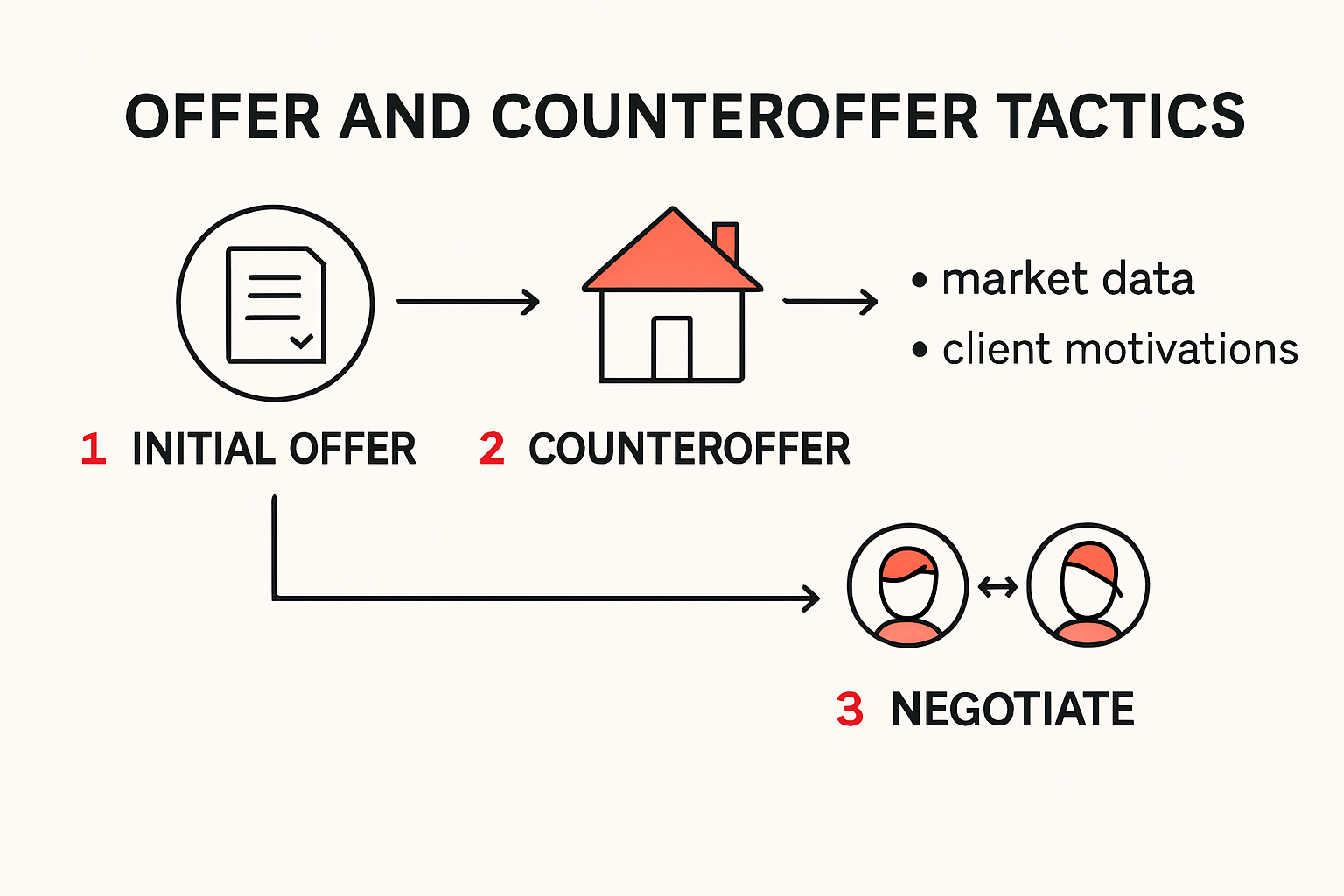
Offer and counteroffer tactics represent the strategic core of real estate negotiations. Successful agents understand that these interactions are complex dance of value creation, psychological positioning, and strategic communication.
Crafting Strategic Initial Offers
The initial offer sets the negotiation tone and establishes a critical psychological framework. According to the Program on Negotiation at Harvard Law School, effective negotiators view offers as collaborative opportunities rather than adversarial challenges.
Key principles for crafting strategic initial offers include:
- Market-Aligned Pricing: Grounding offers in comprehensive market research
- Psychological Positioning: Creating offers that feel reasonable yet advantageous
- Flexibility Framework: Building negotiation space within the initial proposal
Research indicates that offers within 10-15% of market value typically generate more productive conversations. This approach demonstrates serious intent while leaving room for constructive dialogue.
Advanced Counteroffer Techniques
Counteroffering requires nuanced understanding of underlying client motivations and market dynamics. Research from machine learning negotiation studies suggests that strategic counteroffers involve more than financial adjustments.
Effective counteroffer strategies include:
- Identifying non-monetary negotiation elements
- Understanding emotional and practical client priorities
- Creating multi-dimensional value propositions
- Demonstrating empathy and professional adaptability
Professional agents recognize that counteroffers are opportunities to reframe discussions and uncover mutually beneficial solutions. This approach transforms potential conflicts into collaborative problem-solving experiences.
Negotiation Technology and Data-Driven Tactics
Modern real estate negotiations leverage advanced technological tools to enhance strategic decision-making. Our guide on handling objections highlights the importance of integrating technological insights into negotiation strategies.
Technology-enabled negotiation tactics involve:
- Real-time market data analysis
- Predictive modeling of potential negotiation outcomes
- Comprehensive comparative market assessments
- Advanced communication tracking systems
Agents who combine traditional negotiation skills with technological insights create powerful competitive advantages. They can anticipate market trends, understand client psychology, and craft sophisticated negotiation approaches.
Ultimately, mastering offer and counteroffer tactics requires continuous learning, adaptability, and a commitment to understanding complex human dynamics within real estate transactions.
Building Long-Term Relationships Through Negotiation
Successful real estate professionals understand that negotiation extends far beyond single transactions. Long-term relationship building represents the cornerstone of sustainable professional success in the real estate industry.
Trust as the Foundation of Negotiation
According to the Program on Negotiation at Harvard Law School, trust is the critical element that transforms transactional interactions into lasting professional relationships. Agents who prioritize relationship building create networks that generate consistent referrals and repeat business.
Key strategies for building trust during negotiations include:
- Transparent Communication: Providing clear, honest information at every stage
- Consistent Follow-Up: Maintaining communication beyond immediate transaction requirements
- Demonstrating Expertise: Sharing market insights and professional knowledge
Trust-building requires agents to shift from a transaction-focused mindset to a client-centric approach that values long-term connections over immediate gains.
Below is a summary table of strategies for building long-term trust and relationships during negotiations, highlighting how each strategy reinforces professional credibility and ongoing engagement.
| Strategy | How It Builds Trust & Relationships |
|---|---|
| Transparent Communication | Fosters honesty and sets clear expectations |
| Consistent Follow-Up | Shows commitment to client success beyond transactions |
| Demonstrating Expertise | Positions agent as a knowledgeable and trusted advisor |
| Personalized Market Insights | Tailors advice, increasing client confidence |
| Post-Transaction Support | Encourages referrals and repeat business |
Value Creation Beyond Financial Transactions
Effective negotiators recognize that value extends beyond monetary considerations. Our guide on prospecting strategies emphasizes the importance of understanding client needs holistically.
Value creation strategies include:
- Providing personalized market insights
- Offering post-transaction support
- Connecting clients with professional networks
- Delivering ongoing educational resources
Real estate professionals who demonstrate commitment to client success build reputations that transcend individual transactions. They become trusted advisors rather than mere service providers.
Relationship Maintenance and Continuous Engagement
Long-term relationship building requires systematic approach to client engagement. Successful agents develop comprehensive communication strategies that maintain connections well beyond initial transactions.

Effective relationship maintenance involves:
- Regular check-in communications
- Personalized market updates
- Celebrating client milestones
- Providing ongoing professional guidance
Advanced agents leverage technology to create scalable relationship management systems. These platforms enable personalized communication while maintaining efficiency across large client networks.
Ultimately, successful negotiation is an art of creating mutual value, building trust, and establishing enduring professional relationships that generate sustained success in the dynamic real estate market.
Frequently Asked Questions
What are some effective strategies for understanding client motivations in real estate negotiations?
To understand client motivations, agents should conduct comprehensive initial consultations, use active listening techniques like reflective responses, and design detailed questionnaires to uncover deeper client objectives.
How can market intelligence enhance negotiation power for real estate agents?
Market intelligence provides insights into local pricing trends, inventory fluctuations, and demographic shifts. By staying informed on these factors, agents can align client expectations with market realities, making their negotiation strategies more effective.
What role does communication play in successful real estate negotiations?
Effective communication is crucial in real estate negotiations. Agents must master both verbal and nonverbal communication to build trust, understand client needs, and navigate discussions to create mutually beneficial outcomes.
What are the key elements of crafting a strategic initial offer in real estate?
A strategic initial offer should be market-aligned, psychologically positioned to feel reasonable yet advantageous, and flexible enough to allow room for constructive dialogue and negotiation.
Take Your Real Estate Negotiations to the Next Level with AI Power
If you feel pressure from missed opportunities or see deals lost because you cannot respond or nurture every lead in time, you are not alone. This article highlights how today’s agents must combine personal negotiation skills, quick response, and keen market awareness just to keep up. Real success is about mastering deep client motivations, staying on top of trends, and building trust, but manual lead management drains your time and leaves gaps.

Why let another hot prospect slip through the cracks? LeadLinker.co gives real estate agents and teams an AI assistant that never sleeps. The platform automatically responds 24/7, qualifies leads, overcomes objections, and books appointments right in your calendar. Learn more about how AI-powered lead management can increase your conversion rates and help you focus on relationships, not repetitive manual tasks. Take the next step now and turn your negotiation skills into real growth by letting LeadLinker handle the busywork for you.