
Every real estate deal starts with a simple question. Who is really ready to work with you and who is just curious? Realtors often think all contacts are created equal, but they are not even close. In fact, professionals who strategically separate leads from contacts can improve their conversion rates by up to 35 percent. That kind of edge can change the entire game—if you know how to spot the difference.
Table of Contents
- Defining Leads And Contacts In Real Estate
- The Importance Of Distinguishing Between Leads And Contacts
- How Leads And Contacts Fit Into The Sales Funnel
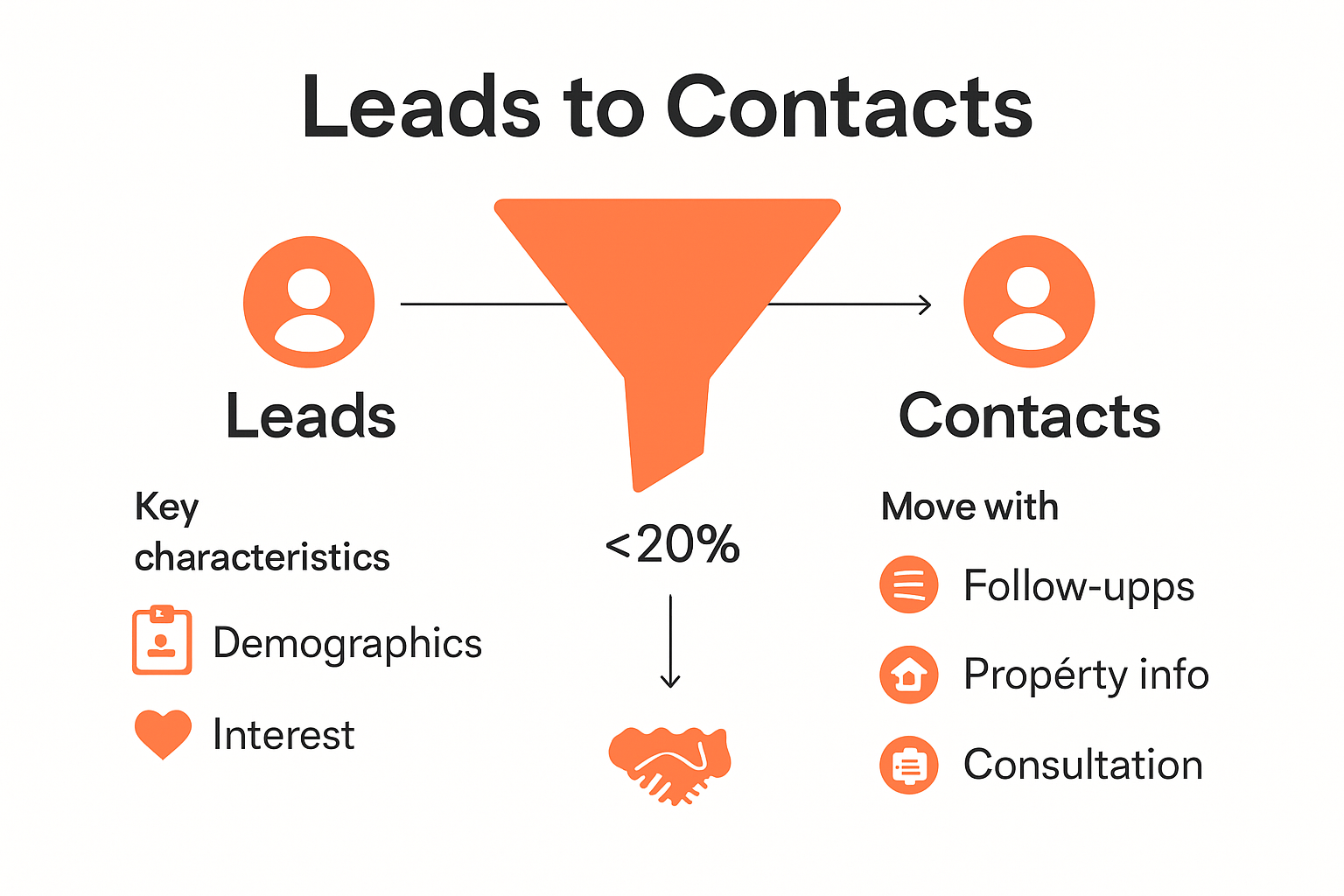
- Key Characteristics Of Leads And Contacts
- Real-World Applications: Using Leads And Contacts Effectively
Quick Summary
| Takeaway | Explanation |
|---|---|
| Differentiate Leads and Contacts | Leads are initial prospects; contacts show deeper engagement and potential for transactions. |
| Use Tailored Communication Strategies | Adapt communication approaches based on prospect stage to enhance engagement and conversion rates. |
| Invest in Relationship Nurturing | Leads need nurturing; contacts require personalized follow-up to maximize conversion potential. |
| Leverage CRM Technology | Utilize advanced CRM tools to track interactions and optimize management of leads and contacts. |
| Understand the Sales Funnel Stages | Familiarize yourself with lead progression through the sales funnel to better tailor your strategies. |
Defining Leads and Contacts in Real Estate
In the competitive world of real estate, understanding the nuanced difference between leads and contacts forms the foundation of effective client relationship management. While these terms are often used interchangeably, they represent distinct stages in a potential client’s journey.
To clarify the often-confused roles of leads and contacts in real estate, the following table compares their definitions, key characteristics, and the type of engagement required.
| Category | Leads | Contacts |
|---|---|---|
| Definition | Initial potential clients showing some curiosity | Prospects with deeper engagement and a higher likelihood |
| Information | Minimal, often just basic contact details | Detailed personal/property info collected |
| Engagement | Limited interaction, unqualified | Multiple meaningful interactions, established rapport |
| Conversion Likelihood | Low to moderate; requires nurturing | High; closer to transaction-ready |
| Action Required | Qualify and nurture | Personalized follow-up and targeted communication |
What is a Real Estate Lead?
A real estate lead represents an initial point of potential interest from an individual who might be considering buying, selling, or investing in property. These are prospects who have demonstrated some level of curiosity about real estate services but have not yet established a formal relationship. Learn more about identifying promising real estate leads.
Key characteristics of real estate leads include:
- Minimal interaction with the real estate professional
- Limited or basic contact information
- Potential interest not yet fully confirmed
- Requires initial qualification and nurturing
Understanding Real Estate Contacts
Contacts represent a more advanced stage in the client relationship. These are individuals who have provided more comprehensive information and have engaged more meaningfully with a real estate professional. Contacts have typically moved beyond initial curiosity and show genuine potential for conversion.
Distinguishing features of real estate contacts include:
- More detailed personal and property information
- Multiple interactions with the real estate agent
- Higher likelihood of potential transaction
- Established communication channel
According to research from the National Association of Realtors, understanding these distinctions can significantly improve lead conversion strategies. Real estate professionals who recognize the unique characteristics of leads and contacts can develop more targeted, personalized approaches to client engagement.
The Importance of Distinguishing Between Leads and Contacts
In real estate, the strategic differentiation between leads and contacts is not merely a semantic exercise but a critical component of effective client relationship management. Recognizing the unique characteristics and potential of each category enables real estate professionals to optimize their communication, resource allocation, and conversion strategies.
Strategic Resource Allocation
Properly classifying leads and contacts allows real estate professionals to allocate resources more efficiently. Leads require initial engagement and nurturing, while contacts demand more personalized attention and targeted communication strategies. Learn more about prioritizing leads effectively.
Key strategic considerations include:
- Different communication approaches for leads versus contacts
- Varied time and effort investment based on potential conversion probability
- Customized follow-up strategies reflecting relationship stage
- Precise tracking of interaction progression
Conversion Optimization Techniques
Understanding the distinction between leads and contacts directly impacts conversion rates. Contacts represent a more developed relationship with higher transactional potential, whereas leads require systematic cultivation to progress through the sales funnel.
Critical optimization techniques encompass:
- Implementing targeted communication protocols
- Developing relationship-specific engagement workflows
- Creating segmented marketing approaches
- Measuring interaction quality and progression metrics
According to research from the National Association of Realtors, real estate professionals who systematically distinguish and manage leads and contacts can improve conversion rates by up to 35%. This nuanced approach transforms potential opportunities into successful transactions by recognizing each prospect’s unique journey and potential.

How Leads and Contacts Fit into the Sales Funnel
The sales funnel represents a strategic framework that visualizes the client acquisition journey, mapping how potential prospects transform from initial interest to committed transactions.
The table below summarizes the stages of lead and contact progression through the real estate sales funnel, helping agents visualize where each prospect stands and tailor engagement strategies appropriately.
| Funnel Stage | Description | Who Typically Occupies Stage |
|---|---|---|
| Awareness | Initial discovery of real estate services | Leads |
| Interest | Shows curiosity about properties or services | Leads |
| Consideration | Evaluates specific opportunities or begins serious inquiry | Leads/Contacts |
| Intent | Indicates commitment to transact | Contacts |
| Evaluation | Assesses credentials/options before agreement | Contacts |
In real estate, understanding how leads and contacts navigate this progression is crucial for developing targeted engagement strategies.
Stages of Lead Progression
The sales funnel typically encompasses multiple stages where leads evolve and transition. Initial awareness marks the entry point, where potential clients first encounter a real estate professional’s services. Explore the comprehensive real estate sales funnel guide to understand these critical transitions.
Key progression stages include:
- Awareness: Initial discovery of real estate services
- Interest: Demonstrating curiosity about potential property transactions
- Consideration: Actively evaluating specific real estate opportunities
- Intent: Showing genuine commitment to potential transaction
- Evaluation: Comparing options and assessing professional credentials
Contact Conversion Mechanics
As leads progress through the funnel, they transform into contacts through meaningful interactions and demonstrated potential. This transition involves progressively deeper engagement, moving from passive interest to active consideration.
Critical conversion mechanisms encompass:
- Consistent and personalized communication
- Demonstrating professional expertise
- Providing targeted property recommendations
- Building trust through transparent interactions
- Addressing specific client needs and preferences
According to research from the National Association of Realtors, successful real estate professionals recognize that not all leads will convert, but strategic funnel management can significantly improve overall conversion rates. Understanding each stage helps professionals allocate resources effectively and develop nuanced approaches tailored to individual client journeys.
Key Characteristics of Leads and Contacts
In real estate, distinguishing the nuanced characteristics of leads and contacts is fundamental to developing effective client engagement strategies. These categories represent distinct stages of potential client relationships, each with unique attributes and requirements for successful conversion.
Lead Identification Markers
Leads are preliminary prospects with potential interest in real estate services. They represent the initial stage of client interaction, characterized by limited but promising engagement. Discover comprehensive insights on identifying real estate leads.
Significant lead characteristics include:
- Minimal personal information availability
- Initial, often surface-level interaction
- Uncertain transaction readiness
- Potential sourced from diverse channels
- Requiring comprehensive qualification processes
Contact Progression Indicators
Contacts represent a more advanced relationship stage, demonstrating higher engagement and transaction potential. These prospects have transitioned beyond initial curiosity, showing genuine interest and more substantial interaction with real estate professionals.
Distinctive contact characteristics encompass:
- Comprehensive personal and property preferences
- Multiple meaningful interactions
- Clear indication of transaction intent
- Established communication rapport
- Higher probability of conversion
According to research from the National Association of Realtors, successful real estate professionals recognize that strategic differentiation between leads and contacts enables more targeted, efficient client relationship management. Understanding these distinctive characteristics allows agents to customize communication approaches, allocate resources effectively, and optimize conversion potential.
Real-World Applications: Using Leads and Contacts Effectively
Effective lead and contact management represents a critical strategic capability for real estate professionals seeking to maximize conversion potential and optimize client relationship development. Implementing sophisticated yet practical approaches transforms raw prospect data into meaningful business opportunities.
Strategic Communication Frameworks
Targeted communication strategies are fundamental to leveraging leads and contacts effectively. Real estate professionals must develop nuanced communication approaches that recognize the distinct characteristics of each prospect category. Learn about advanced lead management techniques.
Key communication strategy components include:
- Personalization based on prospect stage
- Frequency and channel optimization
- Contextual messaging alignment
- Progressive information disclosure
- Adaptive response mechanisms
Technological Integration and Management
Modern real estate professionals leverage sophisticated customer relationship management (CRM) technologies to track, analyze, and engage leads and contacts with unprecedented precision. These technological platforms enable comprehensive prospect tracking, ensuring no potential opportunity falls through communication gaps.
Critical technological integration practices encompass:
- Automated lead scoring mechanisms
- Multi-channel communication tracking
- Real-time interaction analytics
- Segmentation and categorization tools
- Predictive engagement algorithms
According to research from the National Association of Realtors, agents who systematically implement advanced lead and contact management strategies can increase conversion rates by up to 40%. The key lies in understanding each prospect’s unique journey and providing precisely tailored interactions that address their specific real estate needs and preferences.
Bridge the Gap Between Leads and Contacts With Smart Automation
Are you finding it difficult to distinguish between real estate leads and contacts, or struggling to qualify and nurture each with the right level of attention? The article highlights how missed follow-ups, ineffective communication, and slow response times can cause potential clients to slip away before they ever become true contacts. This challenge is all too common when you are trying to manage lead qualification and conversion manually or across multiple platforms. Imagine never missing an opportunity by responding instantly and personally to every single inquiry that enters your funnel.

Let LeadLinker.co help you transform the way you manage incoming leads and contacts with cutting-edge AI technology. Our platform automates your lead response using multi-channel communication and qualifies prospects by asking targeted questions, so you focus on converting the right clients at the right stage. Find out how you can improve conversion rates and save time by exploring advanced lead management techniques, or dive deeper into what makes a high-potential lead. Act now to see how LeadLinker can unlock efficiency, boost your growth, and create more opportunities from every stage of your sales pipeline.
Frequently Asked Questions
What is a real estate lead?
A real estate lead is an initial point of potential interest from someone considering buying, selling, or investing in property. Leads typically have minimal interaction with real estate professionals and require initial qualification and nurturing.
How do leads differ from contacts in real estate?
Leads are preliminary prospects with basic engagement and limited information, while contacts are individuals who have provided more comprehensive details and engaged meaningfully, showing a higher likelihood of conversion.
Why is it important to distinguish between leads and contacts?
Differentiating between leads and contacts allows real estate professionals to allocate resources more efficiently, optimize communication strategies, and improve overall conversion rates based on each stage of the client’s journey.
How can real estate professionals manage leads and contacts effectively?
Real estate professionals can manage leads and contacts by implementing targeted communication strategies, utilizing CRM technologies for tracking interactions, and developing relationship-specific engagement workflows.