
Lead routing is the secret engine behind some of the most successful sales teams and real estate agencies. Most people assume the key is just collecting more leads or having plenty of agents on standby. But get this. According to NAR’s 2024 research report, most home buyers only contact a single agent during their search. The real battle is won not with more leads but by being the fastest and smartest in matching the right professional to the right opportunity every single time.
Table of Contents
- Defining Lead Routing: Core Concepts And Terminology
- The Importance Of Lead Routing In Real Estate Marketing
- How Lead Routing Works: Mechanisms And Processes
- Key Elements Of Effective Lead Routing Systems
- Real-World Applications And Benefits Of Lead Routing
Quick Summary
| Takeaway | Explanation |
|---|---|
| Lead routing enhances sales conversions. | Effective lead routing ensures that leads are matched with the right sales representatives, increasing the likelihood of successful transactions. |
| Speedy responses improve client trust. | Immediate lead routing leads to faster communication, creating a positive first impression that can retain potential clients. |
| Data quality is critical for success. | Accurate and integrated lead data enhances routing efficiency, improving conversion rates significantly. |
| Algorithmic routing optimizes lead distribution. | Utilizing advanced routing techniques ensures leads are assigned based on skills, availability, and geography, which boosts efficiency. |
| Personalized communication drives engagement. | Tailoring interactions based on specific lead needs fosters stronger relationships and encourages potential clients to engage. |
Defining Lead Routing: Core Concepts and Terminology
Lead routing represents a critical strategic process in sales and marketing where incoming potential customer inquiries are systematically distributed to the most appropriate sales representatives or teams. At its core, lead routing transforms raw contact information into actionable opportunities by ensuring each lead reaches the right professional who can effectively convert their interest into a potential transaction.
Key Components of Lead Routing
Understanding lead routing requires recognizing several fundamental elements that drive its functionality. These components work together to create an efficient lead management system:
The following table outlines the fundamental components involved in a lead routing system, providing concise definitions to clarify each concept for readers.
| Component | Definition |
|---|---|
| Lead Capture | Collecting potential customer data from sources like websites, social media, or events |
| Lead Qualification | Assessing a lead’s value and readiness to purchase based on set criteria |
| Assignment Rules | Logic used to determine how leads are allocated to sales team members |
| Data Validation | Ensuring all lead information is accurate and complete |
| Deduplication | Removing duplicate or conflicting lead entries |
- Lead Capture: The initial stage where potential customer information is collected through various channels like websites, landing pages, social media, or events
- Lead Qualification: Assessing the potential value and readiness of a lead based on predefined criteria
- Assignment Rules: Predetermined logic determining how leads are distributed among sales team members
Strategic Distribution Mechanisms
Lead routing is not a random assignment process but a calculated approach with multiple distribution strategies. According to Harvard Business Review, companies implementing structured lead routing can significantly improve their conversion rates by reducing response times and matching leads with the most suitable representatives.
The distribution can occur through various methods such as:
To help clarify how different lead routing distribution strategies compare, the following table summarizes key methods, their descriptions, and the primary benefit of each approach.
| Routing Method | Description | Primary Benefit |
|---|---|---|
| Round Robin | Evenly assigns leads to all agents in rotation | Fair opportunity allocation |
| Skill-Based Routing | Matches leads with agents who have the specific expertise | Higher conversion through expertise |
| Geographic Routing | Assigns leads based on the agent’s territory or region | Local market knowledge |
| Rules-Based Routing | Follows predetermined criteria for lead assignment | Customization and flexibility |
| Time-Based Routing | Distributes leads based on agent availability or response time | Faster response to leads |
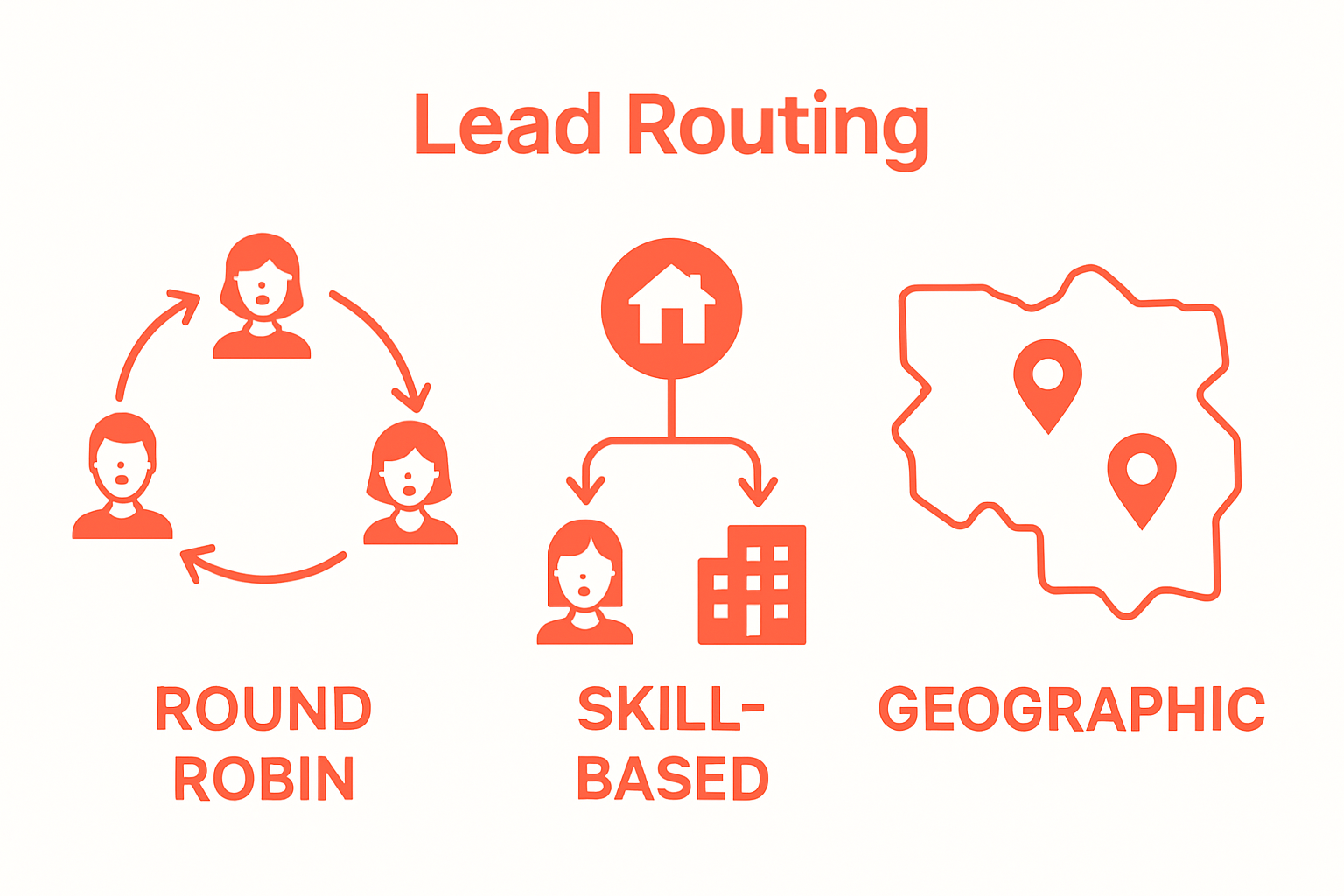
- Round Robin: Evenly distributing leads across team members to ensure fair opportunity allocation
- Skill-Based Routing: Matching leads with representatives who have specific expertise relevant to the inquiry
- Geographic Routing: Assigning leads based on territorial boundaries or regional specializations
Effective lead routing goes beyond simple distribution. Learn more about managing real estate leads to understand how strategic lead management can transform your business approach. By implementing sophisticated routing mechanisms, organizations can optimize their sales processes, reduce response times, and ultimately increase the likelihood of successful conversions.
The Importance of Lead Routing in Real Estate Marketing
Lead routing is a pivotal strategy that transforms how real estate professionals capture, manage, and convert potential client opportunities. In a competitive market where speed and precision determine success, effective lead routing can mean the difference between closing a deal and losing a potential client to another agent.
Performance and Efficiency Impact
The significance of lead routing extends far beyond simple contact distribution. According to NAR’s 2024 Research Report, most home buyers contact only one agent during their property search. This statistic underscores the critical nature of making an exceptional first impression through rapid, targeted communication.
Key performance benefits of strategic lead routing include:
- Faster Response Times: Immediate routing ensures potential clients receive prompt attention
- Improved Conversion Rates: Matching leads with specialized agents increases likelihood of successful transactions
- Enhanced Client Experience: Personalized, quick communication builds trust and credibility

Strategic Differentiation in Real Estate Marketing
Real estate professionals who implement sophisticated lead routing gain substantial competitive advantages. By leveraging intelligent routing mechanisms, agents can:
- Optimize team productivity by matching leads with agents possessing relevant expertise
- Create more personalized initial interactions
- Reduce potential lead abandonment through streamlined communication processes
Discover advanced lead management techniques that can transform your real estate business strategy. Effective lead routing is not just a technological solution but a strategic approach that enables real estate professionals to maximize their potential client interactions, ultimately driving growth and success in an increasingly digital marketplace.
How Lead Routing Works: Mechanisms and Processes
Lead routing operates as a sophisticated system of rules, algorithms, and decision-making processes designed to efficiently distribute incoming leads to the most appropriate sales representatives. This intricate mechanism transforms raw contact information into strategic opportunities through intelligent allocation strategies.
Algorithmic Routing Techniques
At the core of lead routing are advanced algorithmic approaches that go beyond simple random assignment. According to U.S. General Services Administration contact center guidelines, routing systems analyze multiple attributes to make precise lead distribution decisions.
Key algorithmic routing techniques include:
- Rules-Based Routing: Predetermined criteria determining lead assignment
- Time-Based Routing: Distribution based on agent availability and response windows
- Skills-Based Routing: Matching leads with agents having specific expertise
- Geographic Routing: Assigning leads according to territorial boundaries
Processing and Workflow Mechanics
The lead routing process involves multiple interconnected stages that ensure efficient lead management:
- Capturing lead information from various entry points
- Analyzing and qualifying lead potential
- Applying routing rules and criteria
- Instantaneous lead assignment
- Tracking and monitoring lead progression
Explore advanced lead management strategies that can revolutionize how real estate professionals handle potential client interactions. By implementing sophisticated routing mechanisms, organizations create a seamless workflow that maximizes conversion potential and minimizes response times, ultimately transforming how sales teams engage with potential clients.
Key Elements of Effective Lead Routing Systems
Effective lead routing systems represent a sophisticated technological framework that transforms how businesses capture, distribute, and nurture potential customer opportunities. These systems are not merely software solutions but strategic mechanisms designed to optimize sales team performance and maximize conversion potential.
Data Quality and Integration
The foundation of any robust lead routing system lies in data integrity and comprehensive integration. According to Harvard Business Review, companies with precise lead information and rapid response mechanisms are significantly more likely to convert potential clients.
Critical data management elements include:
- Data Validation: Ensuring accurate and complete lead information
- Real-Time Integration: Connecting multiple data sources seamlessly
- Deduplication Processes: Eliminating redundant or conflicting lead entries
Intelligent Routing Criteria
Successful lead routing transcends basic distribution by implementing sophisticated assignment strategies that consider multiple performance variables:
- Skill Matching: Routing leads to representatives with specific expertise
- Performance History: Considering agent conversion rates and specializations
- Availability Windows: Distributing leads based on current team capacity
- Territory Alignment: Assigning leads according to geographic or market segments
Explore proven lead management techniques that can transform your approach to client acquisition. By developing a nuanced, data-driven routing system, organizations create a responsive infrastructure that adapts to changing market dynamics, ensuring each potential client receives personalized, timely attention from the most suitable representative.
Real-World Applications and Benefits of Lead Routing
Lead routing transforms theoretical potential into practical business advantage, providing organizations with a strategic mechanism to convert potential client interactions into successful transactions. By implementing intelligent routing systems, businesses can dramatically improve their sales efficiency and customer engagement strategies.
Industry-Specific Performance Optimization
Different industries leverage lead routing uniquely to address specific operational challenges. According to LinkedIn’s sales allocation research, data-driven routing policies can increase conversion rates by up to 47% compared to traditional assignment methods.
Key industry applications include:
- Real Estate: Matching client inquiries with agents specializing in specific property types or locations
- Financial Services: Routing investment leads to advisors with relevant expertise
- Healthcare: Connecting patient inquiries with appropriate medical specialists
- Technology: Directing technical support requests to representatives with specific product knowledge
Compliance and Risk Management
Beyond performance enhancement, lead routing serves critical compliance and risk mitigation functions. Sophisticated routing systems ensure that:
- Only licensed professionals handle sensitive client interactions
- Regulatory requirements are consistently met
- Potential conflicts of interest are automatically prevented
- Transparent, auditable assignment processes are maintained
Explore advanced lead management strategies that can revolutionize how businesses approach client acquisition. By implementing intelligent, adaptive routing mechanisms, organizations create a responsive infrastructure that not only improves conversion potential but also builds trust through personalized, professional interactions.
Never Miss a High-Value Lead: Transform Your Real Estate Response
Is your team struggling to turn real estate inquiries into booked appointments? Delays in lead routing often cause missed opportunities, especially when speed and qualification matter most. This article explained the importance of strategic distribution, rapid follow-up, and personalized engagement in lead routing. The pain is real when every minute counts and competitors can respond faster. Imagine if every new lead received an instant reply, was qualified with smart questions, and automatically scheduled onto your calendar.
Let LeadLinker.co give you the competitive edge right now. Our AI-powered platform brings together multi-channel communication, real-time lead qualification, and 24-7 response to ensure no lead slips through the cracks. Want proven results to boost conversion while saving money and time? See how agents succeed with smarter lead management in our lead management best practices for real estate and discover how real estate lead management can transform your pipeline. Take the step today and experience how automation and AI can help you outperform the market.
Frequently Asked Questions
What is lead routing?
Lead routing is the process of systematically distributing incoming potential customer inquiries to the most suitable sales representatives or teams. It aims to convert raw contact information into actionable sales opportunities.
Why is lead routing important in sales?
Lead routing is crucial because it ensures prompt and accurate responses to potential clients, which can significantly improve conversion rates and enhance the overall client experience.
What are common methods of lead routing?
Common methods of lead routing include round robin distribution, skill-based routing, and geographic routing, each designed to match leads to representatives based on specific criteria and expertise.
How does lead qualification impact the routing process?
Lead qualification assesses the potential value and readiness of a lead based on predefined criteria, which informs the routing process to ensure that leads are assigned to the most appropriate agents for optimal conversion success.